
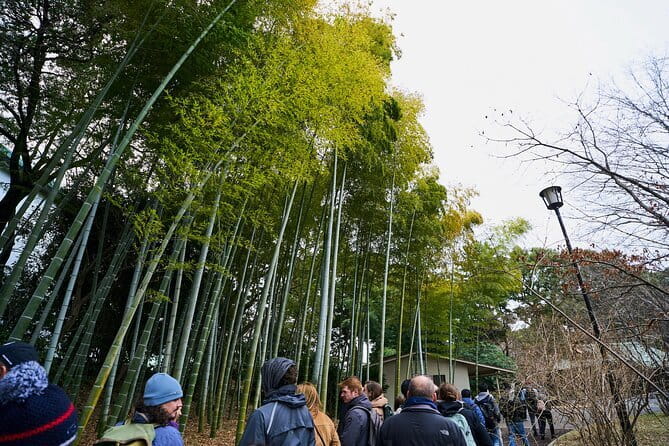
REVIEW · WALKING TOURS
Tokyo Castle & Imperial PalaceーShogun Walking Tour
Tokyo’s Imperial Palace grounds make far more sense once you understand that today’s quiet gardens were once Edo Castle, Japan’s largest fortress and the power center of the shoguns. This two-hour walk follows gates, guardhouses, towers, ruins, and gardens while explaining how the castle was protected and how the samurai system worked.
I like the small-group format, advertised for up to 10 people, and the way the route mixes military history with peaceful garden scenery. Guides such as K, Keiko, Ai, Shin, and Yuuki have been praised for clear English, humor, visual aids, and thoughtful answers. The main drawback is that you do a fair amount of walking in exposed sun, including slopes and stairs, and one unhappy participant found the guide’s English difficult to follow.
Key points at a glance
- Edo Castle’s defense system: Study massive gates, stone walls, guardhouses, and watchtowers that protected the shogun.
- Samurai stories with a human scale: Learn about lower-ranking guards, senior samurai, and daily castle security.
- A rare look at the castle ruins: See the former site of the main tower and a scale model of Edo Castle.
- Ninomaru Garden adds a quiet finish: Koi ponds, seasonal plants, and traditional design balance the military history.
- Strong guide element: Guides including K, Keiko, K, Tomo, Anju, Nana, and Mako have received especially warm praise.
- Simple price, useful context: At $23.88, the tour costs little more than a casual meal and can make otherwise empty walls and lawns meaningful.
Why Edo Castle is the right place to start
The Imperial Palace is not just a royal residence hidden behind walls. It occupies the former center of Edo Castle, a fortress tied to the shoguns and to the rise of Tokyo itself. The castle was never breached, and the tour uses its surviving structures to explain why.
That matters because much of the palace area today is open space, stonework, trees, and carefully kept paths. Without context, you may admire the scenery but miss the military logic. A gate that looks decorative may have slowed attackers. A guardhouse that seems small may have controlled access to the inner castle.
Your guide’s job is to connect those pieces. Several guides have used laminated images, old castle layouts, tower illustrations, and pictures of the imperial family. That kind of visual help is useful when the original buildings are gone or only partly preserved.
The tour is conducted in English only. You should be comfortable listening while walking, asking questions, and following historical explanations in English. Japanese-language support is not available.
More Walking Tours in Japan:
- Tokyo Castle & Imperial PalaceーShogun Walking Tour
★ 4.7 · 1,068 reviews - Ultimate Osaka Walking Tour: Castle, Dotonbori & Hidden Gems
★ 5.0 · 862 reviews - Osaka Castle Walking Tour and Castle Tower Admission
★ 5.0 · 561 reviews
Starting at Sakurada Tatsumi Yagura

The walk begins at Starbucks Coffee in Kokyo Gaien Wadakura Fountain Park, at 3-1 Kōkyogaien in Chiyoda City. This is a practical meeting point near public transportation, but give yourself time to find it in the broad open area around the palace.
The first major sight is Sakurada Tatsumi Yagura, a surviving Edo-period turret. Its purpose was practical, not merely decorative. From here, your guide explains the security systems that helped protect the palace area, including the way towers and walls worked together.
Allow about 20 minutes at this stop. That is enough time to look closely, take pictures, and hear the opening explanation without rushing. It also sets up the rest of the tour: you begin with defense, then move inward through layers of controlled access.
The open surroundings can make the turret seem less intimidating than it once was. Your guide’s explanation helps restore its proper scale and purpose.
Passing through Otemon Gate
Kokyo Otemon Gate brings the castle’s defensive design into sharper focus. You see two massive gates and original stone walls, then learn how this entrance was arranged to protect the shogun.
This is one of the most useful stops for first-time visitors because the architecture is easy to read once someone explains it. The gates were not simply an entrance and exit. Their arrangement, thick construction, and turns made movement slow and controlled.
The stop lasts about 10 minutes. That is short, but the route keeps moving and avoids turning the tour into a long lecture at one location. You will have time for photographs, though the guide’s explanation is the main reason to linger.
Security screening is required to enter the Imperial Palace grounds. Do not bring knives or alcohol. That check is another reminder that you are entering a protected area, not just a public park.
Three guardhouses, three levels of samurai life
The Constable Guardhouse is small and easy to overlook. That is exactly why it benefits from a guide. It was used by lower-ranking samurai, and the stop explains who these men were and why their position mattered to the castle’s security.
Next comes Hyakunin Bansho Guardhouse, a larger building where many samurai were stationed. Its size gives you a better sense of the manpower required to guard the castle. This was not a single sentry post. It was part of an organized system with different duties and ranks.
At Obansho Guardhouse, the focus shifts to higher-ranking samurai stationed near the inner gate. You learn how their responsibilities differed from those of the lower-ranking guards.
Each guardhouse receives about 10 minutes. Taken together, the three stops offer one of the tour’s best teaching sequences. Instead of hearing a general explanation about samurai, you see how rank and responsibility were reflected in specific places.
I especially like this part for families and visitors who know the word samurai but want a clearer picture of what samurai service actually involved. The tour does not treat them as movie characters. It places them within a working castle structure.
A few more castle tours around Japan worth a look
- Osaka Castle: Museum and Tower Entry Ticket
★ 4.5 · 2,380 reviews - Kyoto: Nijo-jo Castle and Ninomaru Palace Guided Tour
★ 4.7 · 1,020 reviews - Kyoto: Nijo Castle, Kiyomizu & Fushimi Inari Guided Tour
★ 4.7 · 700 reviews - Imperial Palace East Garden and Edo Castle Walking Tour in Tokyo
★ 5.0 · 510 reviews
Fujimi-yagura and the castle’s lost height

Fujimi-yagura is an old watchtower overlooking the area. Your guide explains its former role and what made it special. Towers like this gave defenders a view across the grounds and helped maintain control of the castle approaches.
The name is linked to views of Mount Fuji, although the important point on this walk is the tower’s position and purpose. The surviving structure helps you imagine a castle that once rose much higher than the present gardens suggest.
The stop takes about 10 minutes. It is another place where photos are worthwhile, but the visual impact depends on hearing how the tower fitted into the larger defense network.
A model of Edo Castle at Shozokan
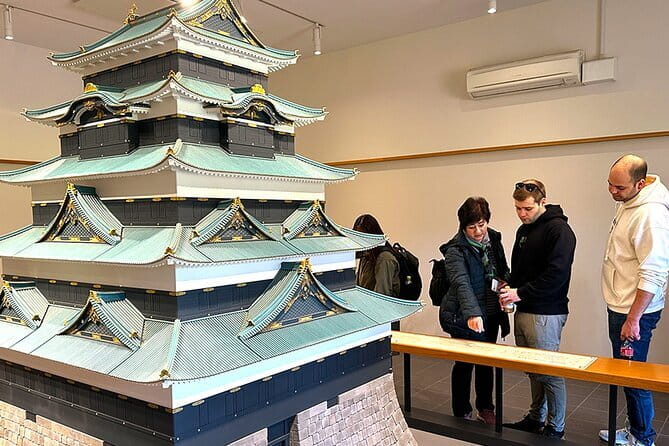
At Kokyo Sannomaru Shozokan, you can see a scale model of the former Edo Castle and visit a souvenir shop with palace-related goods. This is a valuable pause because the model supplies what the grounds cannot: a sense of the complete castle complex.
After seeing scattered gates, walls, guardhouses, and towers, you can finally picture how those pieces related to one another. The model also helps explain why the site once required so many guards and layers of access.
The stop is listed at about 10 minutes. Do not expect a long museum visit. Think of it as a compact visual aid during the walking route, with a chance to browse palace-themed items.
The main tower ruin and what no longer exists
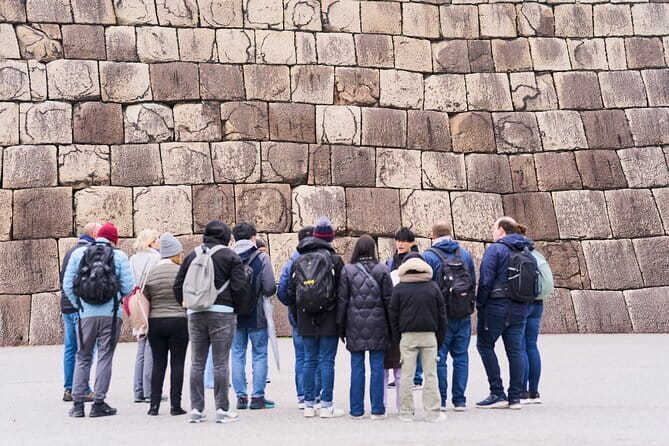
The East Gardens of the Imperial Palace contain the former site of Edo Castle’s main tower. The tower itself is gone, and the guide explains why it no longer stands and what remains today.
This is a good place to pause and consider the difference between survival and absence. Japan’s most important castle site is not presented as a fully rebuilt attraction. Instead, you see the foundations and remaining traces, then use the explanation to imagine the structure that once dominated the grounds.
The stop lasts about 15 minutes. If you prefer intact castles with reconstructed interiors, this part may feel understated. If you enjoy seeing how a historic site has changed over time, it is one of the most thought-provoking moments of the tour.
The Imperial Palace itself is not fully open to public sightseeing. In particular, the Emperor’s residence is not open to the public, so this experience is about the surrounding historic grounds rather than entering the royal home.
Ninomaru Garden brings the pace down
After walls, gates, towers, and military ranks, Ninomaru Garden changes the mood. This traditional Japanese garden includes seasonal plants and a pond with koi. It shows the former castle grounds in a quieter, more refined way.
I like this contrast. The tour does not leave you with only fortifications and political power. You also see the careful garden design associated with the palace grounds, with water, plants, and open views offering a calm finish.
The stop is planned for about 15 minutes. Use it to slow down, take photographs, and ask final questions. A guide may explain how the garden fits into the wider former castle site, but it also works as a simple breathing space after the more technical security discussion.
One practical note: the walk is not completely flat or effortless. You will encounter steep slopes and stairs, and much of the route can be exposed to sun. Comfortable shoes, water, and sun protection are sensible. One particularly hot-day account praised a guide for handing out sweets and menthol napkins, but you should still bring your own water and protection.
Finishing near Tokyo Station
The tour concludes at a ginkgo-lined avenue stretching toward Tokyo Station. This gives you a strong final city view: the historic palace grounds behind you and modern Tokyo ahead.
The supplied meeting information says the activity ends back at the meeting point, while the route description places the final conclusion near Tokyo Station. Because of that wording, check the exact end instructions when you book or meet your guide. Either way, the route is positioned in central Tokyo and near public transportation.
The final avenue also makes the tour easy to pair with other sightseeing in the Marunouchi area. You can continue toward Tokyo Station, stop for food, or use nearby transport rather than returning to a distant neighborhood.
Guide quality makes the difference
This tour depends heavily on the person leading it. The strongest guides have included K, Keiko, Ai, Shin, Tomo, Anju, Nana, Yuuki, Yuta, Mako, Mayuko, and Franky.
K has been praised for clear English, enthusiasm, humor, and the ability to answer questions about the palace, Japanese history, and the imperial family. Keiko has used flashcards and old layouts to make the explanations more visual. Shin has helped explain both the Edo period and the broader grounds, while Tomo has been noted for being accommodating and personable.
That range matters because the structures alone do not provide a full story. A good guide turns a guardhouse into a lesson about rank, a wall into a defensive plan, and a garden into part of the castle’s changing identity.
The experience is not perfect for everyone. One person left early after finding the guide’s English difficult and feeling that a guide was unnecessary for the garden. That is a fair caution. If you want only a quiet stroll, you can see the gardens without paying for commentary. If you want the castle’s military and political background explained as you walk, the guide is the main value.
The booking information describes a small group of up to 10, although the additional activity details list a maximum of 60 participants. Confirm the expected group size if that matters to you. The smaller format is preferable for questions and for keeping close to the guide.
Is $23.88 good value?
At $23.88 per person, this is a low-cost way to add structure to a central Tokyo visit. The ticket does not promise entry to the Emperor’s residence or an indoor palace tour. You are paying for an English-speaking guide, a planned route, and explanations that connect the surviving parts of Edo Castle.
I think the price works best for first-time visitors, families, and anyone who wants a useful introduction to samurai, shoguns, and the imperial system. The two-hour length is also sensible. It is long enough to cover the major points but short enough to fit around Tokyo Station, Ginza, Marunouchi, or other central sights.
You may not need it if you have already studied Edo Castle, prefer exploring alone, or dislike walking in sun and heat. The grounds are free at the stops listed, so the paid part is the interpretation rather than admission to individual monuments.
Free cancellation is available up to 24 hours before the start time. Changes or cancellations made less than 24 hours before the start time are not refunded.
Who should book this walk?
I would choose this tour early in a Tokyo visit if you want historical bearings. It gives you a basic framework for understanding the shogun era, samurai ranks, the imperial system, and the relationship between old Edo and modern Tokyo.
It also suits people who like a moderate amount of history without spending half a day in a museum. The route has frequent stops, photo opportunities, and a garden finish, so it is not a nonstop lecture.
You should think twice if stairs and slopes are a serious concern, if you need Japanese-language support, or if you want access to the Emperor’s residence. Bring water, wear comfortable footwear, and protect yourself from the sun. The tour is more enjoyable when you treat it as an outdoor history walk rather than a palace interior visit.
Should you book the Tokyo Castle and Imperial Palace Shogun Walking Tour?
Book it if you want the Imperial Palace grounds to make sense instead of simply looking pretty. The best reason to go is the combination of surviving defenses, samurai guardhouses, the main tower ruin, the Edo Castle model, and Ninomaru Garden, all tied together by an English-speaking guide.
At $23.88, the risk is modest. Just confirm the meeting and end details, prepare for stairs and sun, and remember that guide quality can vary. For a first visit to Tokyo, this is a practical, focused introduction to the city’s shogun-era foundations.
FAQ
How long does the tour last?
The tour lasts approximately two hours.
Where does the tour begin?
It begins at Starbucks Coffee in Kokyo Gaien Wadakura Fountain Park, 3-1 Kōkyogaien, Chiyoda City, Tokyo 100-0002, Japan.
Where does the tour end?
The route description says it concludes near the ginkgo-lined avenue stretching toward Tokyo Station. The meeting information says the activity ends back at the meeting point, so check the final instructions when booking.
Is the tour conducted in English?
Yes. The tour is conducted in English only, and Japanese-language support is not available.
Is the Emperor’s residence open to the public?
No. The Emperor’s residence is not open to the public on this activity.
Are there security restrictions?
Yes. You must pass a security check to enter the Imperial Palace grounds. Do not bring knives or alcohol.
Is the tour suitable for most people?
Most people can participate, but the walk includes steep slopes and stairs. Comfortable footwear is recommended.
What is the cancellation policy?
You can cancel up to 24 hours before the experience for a full refund. Cancellations or changes made less than 24 hours before the start time are not accepted for a refund.
Just added around Japan
- Tokyo: Edo Castle and Imperial Palace Guided Walking Tour★ 5.0 · 6 reviews
- (Ticket Included) Explore Osaka Castle & Museum of History★ 4.8 · 21 reviews
- Peace Memorial Park, Hiroshima Castle, & Garden Private Tour★ 4.8 · 7 reviews
- Osaka: Osaka Castle Guided Tour with Local Guide★ 4.7 · 78 reviews
- Osaka: Osaka Castle – Tsuruhashi – Tennoji (Spanish Guide)★ 4.7 · 10 reviews
- Osaka: Early Morning Osaka Castle Guided Tour, Avoid Crowds★ 4.9 · 12 reviews
- Osaka: Explore Every Bit of Osaka Castle in 3 Hours★ 5.0 · 5 reviews
- Osaka: Osaka Castle 3 hours Historical Walking Tour★ 4.6 · 14 reviews
Walking Tours, compared.

Edinburgh Castle: Guided Walking Tour with Entry Ticket
Read our review →
Prague: 3-Hour Walking Tour of Old Town & Prague Castle
Read our review →Edinburgh Castle: Guided Walking Tour with Entry Ticket
Read our review →
Edinburgh Castle Guided Walking Tour in English
Read our review →
Budapest: Buda Castle Walk with Saint Stephen’s Hall
Read our review →

Prague 3-hour Afternoon Walking Tour including Prague Castle
Read our review →
Dubrovnik: City Walls Early Morning or Sunset Walking Tour
Read our review →Browse the lists this tour appears in