
REVIEW · FORTRESS & CITADEL TOURS
Tour of Barceloneta and the Citadel Park
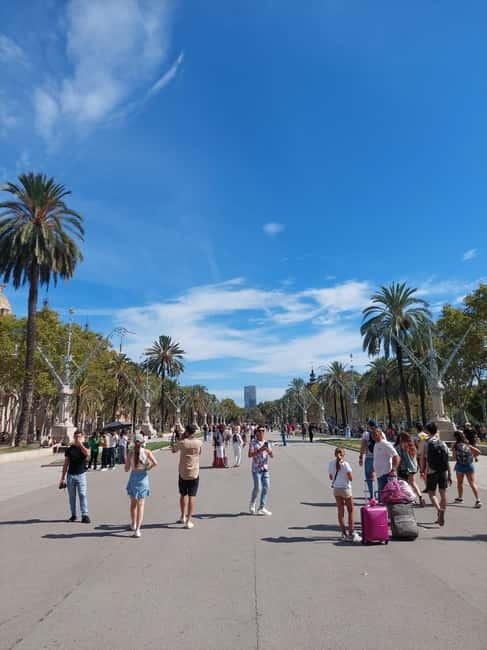
Barcelona’s Arc de Triomphe makes a fine starting point for a walk that links three very different parts of the city: the grand entrance to the 1888 Expo, the gardens of Citadel Park, and the old fishing quarter of Barceloneta. You get Barcelona’s public spaces, political past, railway history, and seaside life in one compact outing.
I like the route for two clear reasons. First, Citadel Park gives you shade, greenery, greenhouses, and the Monumental Waterfall before the walk turns toward the sea. Second, the tour explains how Barceloneta changed from an industrial and maritime district into one of the city’s best-known beach areas after the 1992 Olympic Games. The main concern is reliability: one booking on February 4, 2026 had no guide at the meeting point, no warning, and an unreachable phone number.
- Arc de Triomphe: Built as the main entrance to Barcelona’s 1888 Universal Exposition.
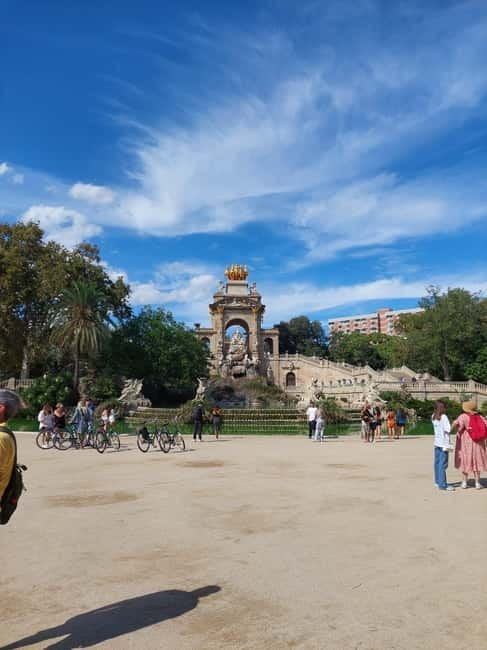
- Citadel Park: See the greenhouses, Monumental Waterfall, and Parliament of Catalonia.
- França Station: Pass one of Barcelona’s oldest railway stations still in operation.
- Barceloneta: Learn about the district’s fishermen, maritime work, and later tourist makeover.
- Italian guide: The entire guided tour is offered in Italian and lasts two hours.
- Low headline price: At $1.19 per person, the cost is unusually small, but service reliability deserves attention.
From the 1888 Expo to the Mediterranean
This is a city walk about change. You begin with Barcelona presenting itself to the world in 1888, move through a former military site turned public park, pass a working railway station, and finish in a neighborhood shaped by fishing, industry, the Olympics, and beach tourism.
That sequence gives the tour a useful shape. You are not simply ticking off monuments. You are walking eastward through different versions of Barcelona. The route also keeps the sightseeing varied. There is architecture at the Arc de Triomphe, greenery in the park, civic history near Parliament, transport history at França Station, and sea views at the end.
The tour lasts two hours, so expect an introduction rather than a full study of each place. If you want long photo stops, detailed museum visits, or time to swim, you will need to continue exploring on your own after the guide says goodbye.
Meeting beneath the Arc de Triomphe
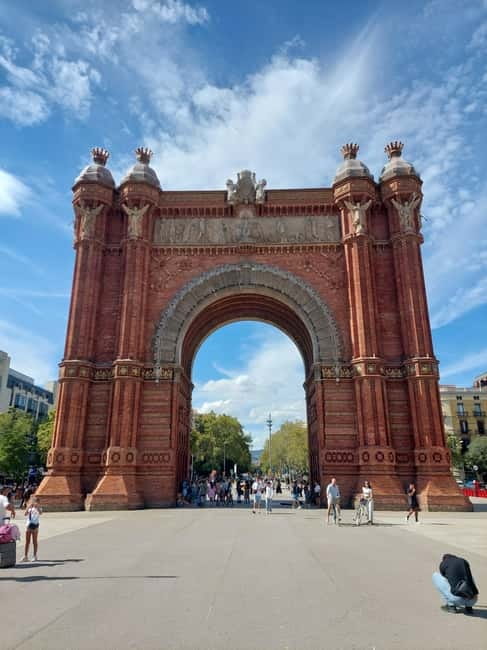
The meeting point is in front of Barcelona’s Arc de Triomphe. This is a practical place to begin because the monument is easy to recognize and immediately gives the guide something important to explain.
The arch was built for the 1888 Barcelona Expo, serving as the main entrance to the event. Unlike a triumphal arch designed only to celebrate a military victory, this one marked a civic and international occasion. That makes it a useful introduction to Barcelona’s ambition in the late nineteenth century.
Look closely at the monument before setting off. Its role as an entrance matters. The tour uses that idea to frame the walk: Barcelona has long used grand public works to announce its place in the world.
Because the exact meeting instructions beyond the general location are not provided here, check the confirmation carefully before you leave. Arrive with enough time to identify the guide and group. One serious service failure was reported when no guide appeared and the listed telephone number could not be reached, so I would save the booking details offline and avoid arriving at the last second.
More Fortress and Citadel Tours in Barcelona:
- Same Day Taj Mahal, Agra Fort & Baby Taj Tour from Delhi by Car
★ 5.0 · 4,304 reviews - Full Day Taj Mahal, Agra Fort & Baby Taj Tour from Delhi by Car
★ 5.0 · 3,647 reviews - Fort Sumter Admission and Self-Guided Tour with Roundtrip Ferry
★ 4.5 · 3,343 reviews
Citadel Park’s greenhouses and Monumental Waterfall
From the arch, the group enters Citadel Park, described as the Catalan capital’s largest urban park. This is the greenest section of the route and gives you a break from streets and traffic.
The tour includes the park’s greenhouses, where you can see exotic and tropical plants. The exact condition of the plants can vary by season and maintenance, so treat this as a short visual stop rather than a guaranteed botanical visit of a set length. Still, the greenhouses add texture to the walk and help show how the former Expo grounds were designed to present Barcelona as modern and outward-looking.
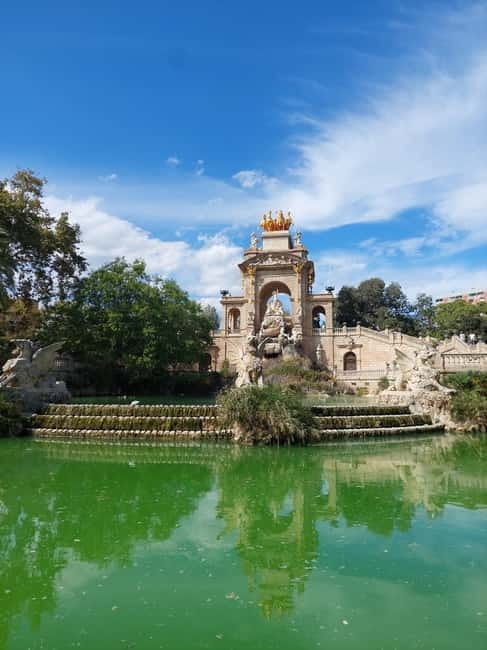
The next major stop is the Monumental Waterfall, designed by architect Josep Fontserè. It is one of the park’s main landmarks and a good place to pause for photographs. The structure gives the tour a strong architectural moment after the formal Arc de Triomphe.
I like this part because the guide can connect design, public space, and the 1888 Expo without asking you to enter a museum. The drawback is time. A two-hour tour covering several districts cannot spend long at every feature, so you may want to return to the park later if the waterfall or greenhouses catches your eye.
Parliament of Catalonia and Barcelona’s political past
The route continues to the Parliament of Catalonia, located within the park. Here the focus shifts from garden design to Barcelona’s political, military, and historical importance.
The Parliament is housed in the former arsenal of the Citadel, according to the historical context presented by the tour. The park itself occupies ground with a military past, so this stop helps explain why the area matters beyond its paths and lawns. You get a reminder that pleasant public gardens can sit on top of complicated civic history.
For you, the value is in the connection between place and power. The guide is not just pointing out a government building. The stop explains how Barcelona’s institutions and military history shaped this part of the city.
This is also where guide quality matters most. The strongest available feedback describes a guide as very prepared and helpful, which suits a stop requiring context rather than a quick name-and-date explanation. The tour is offered in Italian only, so it will be most useful if you can follow historical and political discussion in that language.
França Station and the city’s working connections
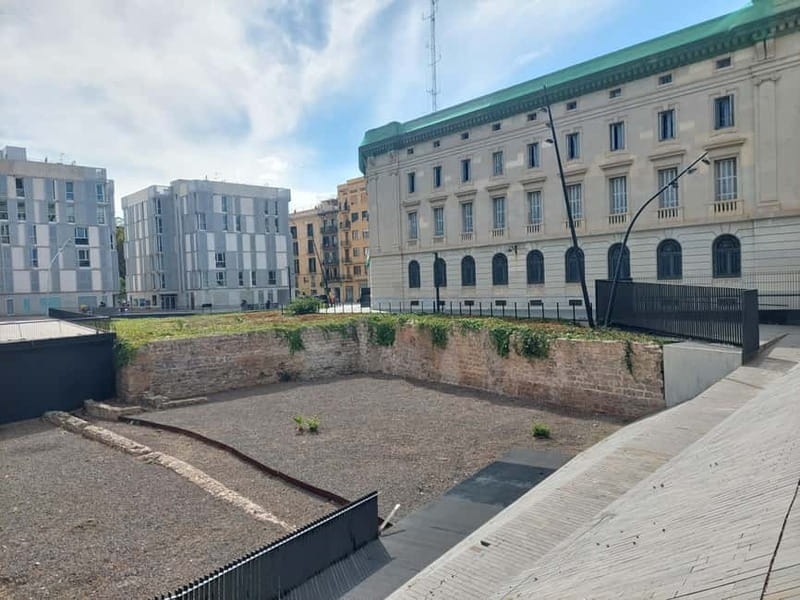
After leaving Citadel Park, you pass França Station, one of Barcelona’s oldest railway stations still in operation. It is a short but worthwhile change of subject.
Rail stations are easy to overlook when a city has famous churches, markets, and beaches. Yet França Station shows how Barcelona connected its port, neighborhoods, and wider rail network. It also keeps the walk grounded in the city’s working life. This is not only a route between monuments. It is a route through places built for movement, trade, government, and daily use.
The provided details do not promise entry into the station or a guided interior visit. Plan to view it as an exterior stop unless the guide says otherwise. If you want an extended look inside, you may need to return independently.
The station also marks the transition toward Barceloneta. The walk moves from the inland park to the coast, and the story changes from Expo planning and civic power to maritime work and neighborhood life.
A few more castle tours around Barcelona worth a look
- Barcelona: Walking tour with Montjuic Castle & Cable Car
★ 4.7 · 832 reviews - Barcelona: Old Town, Montjuic Castle, Cable Car Small Group Tour
★ 4.5 · 445 reviews - Barcelona Cable Car Sky Views, Magic Fountain & Castle Visit
★ 4.2 · 177 reviews - Barcelona Best Views: Old Town, Cable Car and Montjuic Castle
★ 4.5 · 159 reviews
Barceloneta’s fishermen’s homes
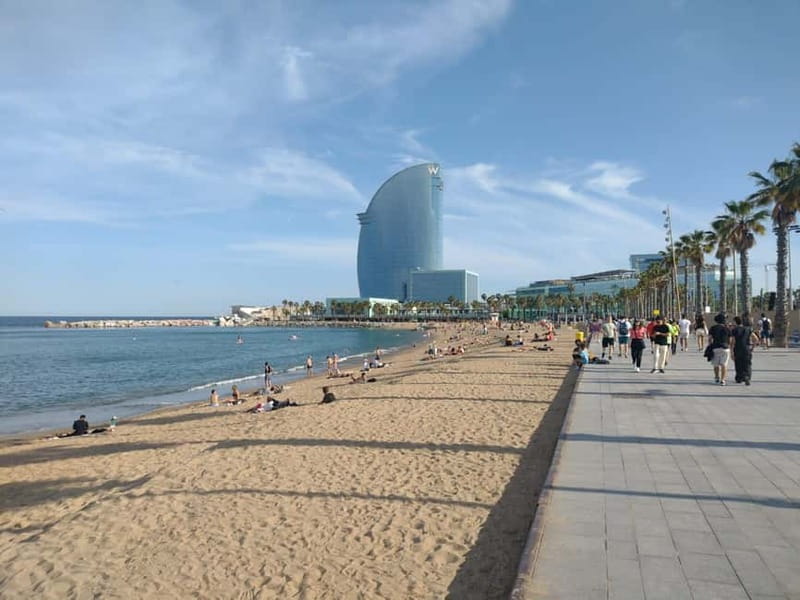
The final district is Barceloneta, where Barcelona meets the Mediterranean. The tour focuses on the old fishermen’s dwellings and the importance of maritime activity to the city.
This is the most local-feeling part of the route, at least in subject matter. The old homes help you picture Barceloneta as a working neighborhood rather than only a beach destination. The guide explains how residents and workers connected the area to the sea, fishing, and port activity.
You should expect to walk through a popular district rather than a preserved open-air museum. The neighborhood has changed over time, and the tour makes that change part of the story. Once industrial, Barceloneta became one of Barcelona’s best-known visitor areas, especially after the 1992 Olympic Games.
That transformation is worth discussing because it raises a practical question: what are you actually seeing today? You are seeing a district shaped by both older maritime traditions and newer beach tourism. The tour gives you a way to look past the sand and restaurants and notice the homes, street pattern, and relationship with the port.
Finishing beside Barceloneta Beach
The walk ends in front of the view of Barceloneta beach. This is a simple finish, but it works well. After the enclosed park and city streets, the open sea gives you a clear final image.
No food, drinks, or bathing are included. That is not a problem for most people, but you should plan accordingly. The final beach view is a stopping point, not a beach day. If you want to swim or sit by the water, bring what you need and allow extra time after the guided walk.
The endpoint also makes the tour easy to extend. You can continue along the waterfront, spend time in Barceloneta, or simply use the beach as a place to rest after two hours on foot. The tour itself does not promise any additional activity after the farewell.
How much value do you get for $1.19?
At $1.19 per person, the advertised price is remarkably low for a two-hour guided walk. If the tour operates as planned, it offers an inexpensive way to connect several sights that you might otherwise visit without a clear thread.
The value is strongest for first-time visitors who want orientation. You receive a route, an Italian-speaking guide, and historical context at places that are free to see from outside. You are not paying entrance fees because the tour does not include a museum, attraction admission, food, drinks, or bathing.
The low price also means you should keep expectations sensible. This is a compact city walk, not a private tour with unlimited questions or a full-day historical course. The current rating is 3.4 from nine ratings, and the most positive specific comment praises the guide’s preparation and willingness to help. That is encouraging, but the reported no-show is a real warning.
I would book only if the cancellation terms fit your plans. You can cancel up to 24 hours in advance for a full refund, and you can reserve now and pay later. Those policies reduce the financial risk, but they do not remove the inconvenience of a missed tour, especially if you have arranged the rest of your day around it.
Language, walking pace, and access
The live guide speaks Italian. Some content is shown in its original language, so this is not the right choice if you need an English or Spanish guided tour.
The duration is two hours, with several outdoor stops and a route from the Arc de Triomphe to the beach. The supplied details do not state the exact distance, group size, or walking pace. You should therefore expect a continuous city walk and wear comfortable shoes.
The activity is listed as wheelchair accessible. That is useful, but the information does not explain the condition of every path, curb, or street crossing. If you need detailed accessibility planning, confirm the route directly before booking.
One practical advantage is the lack of a complicated transport plan. The tour begins at the Arc de Triomphe and finishes at Barceloneta beach. You are not asked to board a bus, train, or cable car as part of this route.
Who should choose this walk?
I would choose this tour if you want a short introduction to east-central Barcelona and can follow Italian comfortably. It fits well into a day that also includes other sightseeing because two hours leaves room before or after for independent plans.
It suits you especially well if you like:
- Public parks and city design
- Short historical explanations at outdoor sites
- Neighborhood change and maritime history
- A guided walk that finishes by the sea
- A very low-cost way to get oriented
I would be more cautious if you need firm operational reliability, a guide in another language, or a slow, highly detailed visit. The no-show report and unreachable phone number are important concerns, even though another specific comment praises the guide’s preparation and helpfulness.
The tour is also not designed for someone seeking a food experience. No tastings, drinks, or meals are included. It is about seeing places and understanding how they connect.
Should you book the Barceloneta and Citadel Park tour?
Book it if the Italian language works for you, you want a two-hour outdoor route, and the $1.19 price gives you useful flexibility. The combination of Arc de Triomphe, Citadel Park, Parliament, França Station, and Barceloneta offers more variety than a simple beach stroll.
I would treat it as a low-cost orientation walk, not the central pillar of your Barcelona schedule. Save your confirmation, arrive early, and keep a backup plan for the day because of the reported no-show. If the guide is present and well prepared, you can get a smart introduction to how Barcelona connects its Expo past, civic spaces, railway links, maritime district, and beach.
FAQ
Where does the tour begin?
The tour begins in front of Barcelona’s Arc de Triomphe.
Where does the tour end?
It ends in front of the view of Barceloneta beach.
How long is the tour?
The guided tour lasts two hours.
What language is the tour offered in?
The live tour guide speaks Italian.
Which main sights are included?
The route includes the Arc de Triomphe, Citadel Park, the Monumental Waterfall, Parliament of Catalonia, França Station, and Barceloneta.
Is the tour wheelchair accessible?
Yes. The activity is listed as wheelchair accessible.
Does the price include food or drinks?
No. Food and drinks are not included.
Can I cancel the booking?
Yes. You can cancel up to 24 hours in advance for a full refund.
Can I reserve now and pay later?
Yes. You can reserve your spot and pay nothing at the time of booking.
Just added around Barcelona
- Montjuïc Cable Car & Magic Fountain Barcelona Private Tour★ 5.0 · 77 reviews
- Montjuic Castle Admission Ticket in Barcelona★ 3.5 · 59 reviews
- Barcelona City Walk with Montjuïc Castle & Cable Car Guided Tour★ 4.0 · 15 reviews
- 2hr Montjuïc Castle Segway Tour★ 5.0 · 5 reviews
- Barcelona Best Views: Old Town and Montjuic Castle Private Tour★ 5.0 · 24 reviews
- Skip-the-line Montjuïc Castle Tour with a Cable Car Ride★ 4.7 · 7 reviews
- Barcelona: Montjuïc e-bike Adventure with Views and Castle★ 5.0 · 9 reviews
- Barcelona: Guitar Trio & Flamenco Dance @Pignatelli Castle★ 4.9 · 47 reviews
Fortress & Citadel Tours, compared.

Full Day Taj Mahal, Agra Fort & Baby Taj Tour from Delhi by Car
Read our review →
Fort Sumter Admission and Self-Guided Tour with Roundtrip Ferry
Read our review →
Carcassonne: Castle and Ramparts Entry Ticket
Read our review →
Charleston: Fort Sumter Entry Ticket with Roundtrip Ferry
Read our review →
Same Day Taj Mahal, Fort & Baby Taj Tour from Delhi by Car
Read our review →
From Delhi: Taj Mahal and Agra Fort Private Sunrise Tour
Read our review →
Sunrise Taj Mahal, Agra Fort & Baby Taj Tour from Delhi by Car
Read our review →
Salzburg: Hohensalzburg Fortress Admission Ticket
Read our review →Browse the lists this tour appears in