
REVIEW · INDIAN FORT & PALACE TOURS
New Delhi: Red Fort Entry Ticket with Optional Add-Ons
The Red Fort is not just a grand red-sandstone entrance. Inside, you find audience halls, royal apartments, museums, and the remains of a Mughal palace city. A private guide helps turn these quiet courtyards and damaged buildings into a readable story, especially at the Diwan-i-Aam and Diwan-i-Khas.
I like the personal pace and the low starting price of $9 per person. Guides such as Gopal, Rambabu, Adil, Pri, and Ali Gufran have been praised for clear explanations, patience, and help beyond the fort itself. The main drawback is meeting at Lahori Gate, which can be confusing in crowded Old Delhi and may require entering from another side first.
Key points at a glance
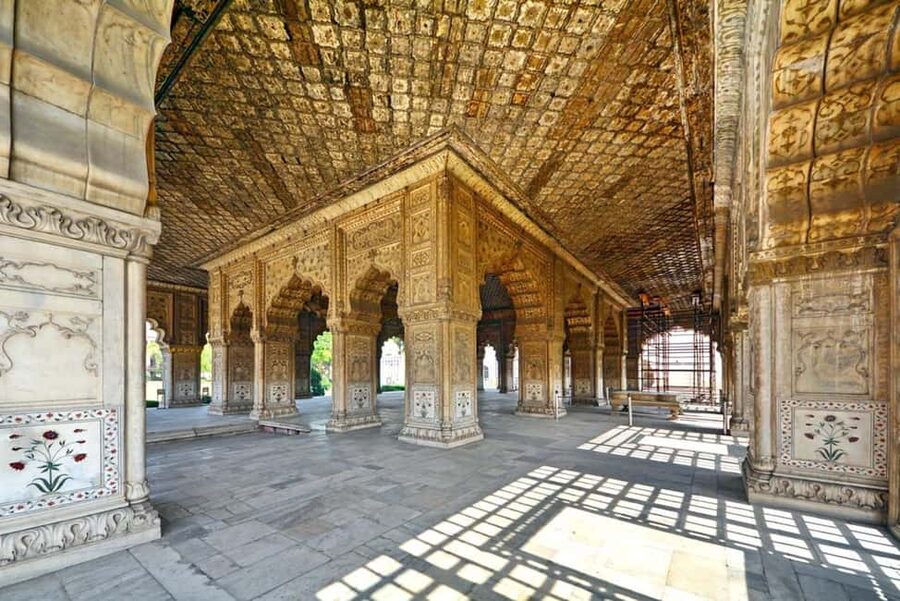
- Begin at the iconic Lahore Gate: Meet your guide near the fort’s best-known entrance and hear why it became a symbol of Mughal power.
- See the emperor’s public and private halls: The Diwan-i-Aam and Diwan-i-Khas reveal two very different sides of court life.
- Choose the right length: A fort-only visit takes about 1.5 hours, while the wider options cover more of Delhi and require a longer day.
- Add Old Delhi street life: The Jama Masjid and Chandni Chowk option pairs major monuments with rickshaw travel and market lanes.
- Expand to four major sights: The full-day route adds Humayun’s Tomb, Lotus Temple, and Qutub Minar.
- Use WhatsApp before you arrive: Your guide contacts you ahead of time, an important help when the fort entrances and Old Delhi streets feel unclear.
Why the Red Fort deserves your time

The Red Fort is one of Delhi’s essential historic sights. Built during the Mughal period, it was designed as a royal residence and center of government, not simply as a defensive wall. You walk through a sequence of gates, halls, gardens, and palace remains that show how the emperor’s public duties and private life once fit together.
The scale can be hard to understand if you explore alone. A guide points out what each space was for and explains how the fort connects to Mughal rule, the 1857 rebellion, and later Indian history. That context is the real value of this experience. The stonework is impressive, but the buildings make more sense when you know who stood in them and why.
The tour is offered as a private group experience, with English or Hindi guidance. That gives you room to ask questions and set a sensible pace. Several guides have been praised for adjusting the visit to families, helping people who arrived late, and allowing extra time instead of rushing through each stop.
More Castle Entry Tickets in India
- Red Fort Delhi Entry tickets with Licensed Tour Guide
★ 4.5 · 78 reviews - Private Tour of Taj mahal and Agra Fort with Guide & Entry Ticket
★ 5.0 · 31 reviews - Skip-the-Line: Agra Fort Entrance Ticket with Guided Tour
★ 5.0 · 25 reviews
Lahore Gate, the fort’s grand first impression
Your visit begins at Lahore Gate, the Red Fort’s famous main entrance. Its scale gives you an immediate sense of Mughal ceremony. This was not a modest doorway. It was designed to announce power before you even reached the inner palace area.
Your guide meets you at or near Lahori Gate and normally contacts you on WhatsApp before the start. Keep your phone active and read the meeting instructions carefully. One important practical point is that the area around the gate can be blocked or difficult to approach directly. You may need to enter from the southern side and walk inside toward the meeting point.
That arrangement can be confusing if you are new to Delhi, particularly in the crowded streets around Old Delhi. I would allow extra time, avoid arriving at the last minute, and ask your guide for a live location if you cannot see the entrance clearly. The guide’s advance WhatsApp message is useful, but the exact meeting directions deserve your attention.
Once inside, the fort becomes calmer than the streets outside. You leave behind the traffic and market noise and begin following the planned route through the historic complex.
Naubat Khana and the sound of royal ceremony

The Naubat Khana, or Drum House, comes next. Royal musicians once performed here, marking important arrivals and court occasions. The building helps you picture the strict order of Mughal court life, where music, movement, and access were carefully controlled.
This is also where a guide adds useful detail. Without an explanation, the Drum House can look like another historic structure along the route. With context, it becomes part of a larger ceremonial system. You begin to understand that the fort was arranged to separate public business, official visitors, royal family spaces, and private life.
The experience may also include a light and sound presentation, depending on the selected option and current arrangements. Treat this as an added way to hear the fort’s story, not as a substitute for seeing the buildings in daylight. The central visit is the guided walk through the site.
Diwan-i-Aam, where the emperor met the public

The Diwan-i-Aam is one of the most important stops. This open audience hall was used by the emperor to hear petitions and address the public. It gives you a clear picture of the Mughal ruler as both monarch and administrator.
Look at the arrangement of the space rather than rushing from one building to the next. The open court, broad approach, and raised royal position were all part of the message. The emperor was accessible in a formal way, but the setting still made the distance between ruler and subject unmistakable.
This is a good place to ask your guide about daily court business and the difference between public and private audiences. Guides including Gyanendra, Mohammed, and Javed Khan have been praised for explaining the fort in a wider Indian context, rather than treating each building as an isolated photo stop.
More Fortress and Citadel Tours in India
- Same Day Taj Mahal, Agra Fort & Baby Taj Tour from Delhi by Car
★ 5.0 · 4,304 reviews - Full Day Taj Mahal, Agra Fort & Baby Taj Tour from Delhi by Car
★ 5.0 · 3,647 reviews - Same Day Taj Mahal, Fort & Baby Taj Tour from Delhi by Car
★ 4.9 · 2,534 reviews - From Delhi: Taj Mahal and Agra Fort Private Sunrise Tour
★ 4.9 · 2,270 reviews
Diwan-i-Khas and the private side of power

The Diwan-i-Khas, or Hall of Private Audiences, is more intimate and decorative than the Diwan-i-Aam. Here, the emperor met officials, diplomats, and other important visitors. The change in scale tells you a great deal: public justice took place in one setting, while high-level discussion and royal display took place in another.
The hall is often remembered for its ornate design and association with Mughal luxury. Much of the fort has changed over time, and the site does not present an untouched royal palace. That is worth keeping in mind. You are seeing surviving structures, altered spaces, and museum displays that together suggest the original complex.
A strong guide will help you separate what remains from what is known about the former palace layout. Ali Gufran, for example, has been praised for answering questions not only about the Red Fort but also about Indian history and culture more broadly. That sort of conversation is particularly useful here, where the architecture raises as many questions as it answers.
Mumtaz Mahal, Zafar Mahal, and the fort museums

The route also includes Mumtaz Mahal and Zafar Mahal. These stops show different stages of the fort’s story and the mix of Mughal and later architectural styles. They are less instantly famous than the Lahore Gate, but they help round out the visit.
Mumtaz Mahal is connected with the royal residential section. Zafar Mahal reflects a later period and helps show that the fort continued to matter after the height of Mughal power. Your guide can explain how the complex changed as political control shifted.
The museums add another layer. Displays include objects connected with the Mughal era and the 1857 rebellion. I would not treat the museums as optional filler. They help bridge the gap between the polished image of Mughal court life and the difficult political events that reshaped Delhi.
You should plan on about 1.5 hours for the fort-focused visit. The time can pass quickly if you enjoy history and stop for questions. If you prefer a slower look at the museums and architecture, confirm the timing with your guide at the start.
Option two: Jama Masjid, rickshaw travel, and Chandni Chowk
The Old Delhi option adds Jama Masjid and Chandni Chowk. It is a better fit if you want more than a single monument and would like to connect royal history with present-day street life.
Jama Masjid is one of India’s largest and most impressive mosques. Its broad courtyard and detailed design make it a major sight in its own right. The visit includes guided sightseeing and walking, so wear comfortable shoes and dress in a way that respects the religious setting.
The transfer between the Red Fort and Jama Masjid includes a pedicab or rickshaw ride of about 75 minutes in the supplied itinerary. Because the timings describe both the ride and the Jama Masjid visit, confirm the exact order and duration with your guide on the day. Delhi traffic and local conditions can affect how this part feels.
Chandni Chowk gives you a very different view of the city. Its lanes are associated with traditional goods, local food, and the daily business of Old Delhi. You get about 30 minutes here on the stated route, enough for a brief look and perhaps a small purchase, but not enough for a relaxed market exploration.
This option suits you if you want a compact history-and-culture outing. It is less suitable if you dislike crowds, narrow streets, or quick changes between formal monuments and busy commercial lanes.
Option three: Four major Delhi landmarks in one day

The longest option begins at the Red Fort and continues to Humayun’s Tomb, the Lotus Temple, and Qutub Minar. It offers a broad look at Delhi’s architecture, but you should choose it only if you are comfortable with a fuller day and more time in transit.
Humayun’s Tomb is a major Mughal garden-tomb and an important step in the development of the style later associated with the Taj Mahal. The site gives you a chance to compare formal gardens, symmetry, domes, and sandstone construction with what you saw at the Red Fort.
The Lotus Temple provides a change of mood. Its lotus-shaped design and quiet atmosphere welcome people of all faiths. After the crowded lanes and imperial spaces of Old Delhi, this stop gives you a calmer architectural experience.
Qutub Minar closes the route with a different chapter of Delhi’s past. The tall brick minaret rises among older ruins linked with the city’s early sultanate period. It is not part of the Mughal story in the same way as the Red Fort or Humayun’s Tomb, which makes it a useful contrast.
The advantage of this option is variety. In one outing, you see Mughal court architecture, a garden-tomb, a modern spiritual building, and a medieval minaret. The trade-off is depth. You will have less time at each place than on a focused Red Fort visit, so choose this route for range rather than a slow study of one monument.
Guides, pace, and the personal service

The strongest part of this experience is the guide. Names that have received especially warm praise include Gopal, Rambabu, Adil, Pri, Mohammed, Gyanendra, Javed Khan, Ali Gufran, and Priyam. The common strengths are clear English, historical explanation, friendliness, and attention to the visitor’s pace.
That last point matters. One guide stayed well over an hour for a late arrival. Another helped a visitor reach the metro afterward. Guides have also helped people who became separated from their tuk-tuk drivers or lost their way in Old Delhi. These are practical touches, not just pleasant conversation.
The service is not limited to memorized dates. Some guides explain daily life in India, local customs, and wider Delhi history. That can make the fort easier to understand, especially if this is your first major Mughal site.
Still, the experience depends on the individual guide and your selected route. If you have children, mobility concerns, or a strong interest in architecture, say so early. The private format should make it easier to adjust the pace, but the route still covers large historic grounds and includes walking.
Is $9 good value?
At $9 per person, the fort-only option is priced well if the entry ticket and guided service are included in the package you select. The listing separates entry tickets and transfers by option, so check exactly what your choice covers before paying.
The value comes from more than getting through the gate. You receive a live English or Hindi guide, help with the meeting point, historical explanation, and a route through several of the fort’s key buildings. For a first visit, that can save time and prevent the site from becoming a series of disconnected photo stops.
The add-on routes offer a different calculation. Jama Masjid and Chandni Chowk give you more local atmosphere, while the wider Delhi route gives you four major sights in one day. If you have only one day in Delhi, that range may be worth the extra cost and longer schedule. If you already have separate plans for Humayun’s Tomb or Qutub Minar, the focused Red Fort visit is the cleaner choice.
Free cancellation up to 24 hours before the start and reserve-now, pay-later terms also reduce planning risk. Do not rely on them as a reason to book without checking the selected option, though. The key decision is whether you want the fort alone or a larger Delhi route.
What to bring and what to expect
Wear comfortable shoes. The visit includes walking through the fort, and the wider choices add more walking at Jama Masjid, Chandni Chowk, and other monuments.
Bring water, a hat, sunscreen, and a camera. Food, alcohol, drugs, smoking, drones, pets, fireworks, plastic bags, and other restricted items are not allowed. Following these rules should make entry easier.
The Red Fort is generally closed around Republic Day for security reasons, from January 20 through January 30. It may also close for several days before and after Independence Day on August 15. Check your date carefully before arranging the rest of your Delhi plans.
Should you book the Red Fort tour?
Book this experience if you want a private guide, a clear introduction to Mughal Delhi, and the option to add Old Delhi or several major monuments. The fort-only route is the best value for a focused visit, while the Jama Masjid and Chandni Chowk option adds more street life without turning the day into a full city circuit.
Choose the longer route if variety matters more than spending extra time inside the Red Fort. I would also book if you are nervous about finding the correct entrance, since the guide’s WhatsApp contact and local help can be valuable.
Skip the add-ons if you prefer slow sightseeing or already have transport and guides arranged elsewhere. Most importantly, confirm the meeting point, entry-ticket inclusion, and selected route before you go. If you do that, this is an inexpensive and useful way to make sense of one of Delhi’s most important historic sites.
FAQ
Where does the Red Fort tour begin?
Your guide meets you at Lahori Gate, the Red Fort entrance, and contacts you on WhatsApp before the tour begins.
How long does the Red Fort visit take?
The fort-focused visit takes about 1.5 hours. The listed activity duration ranges from 1.5 to 2.5 hours, depending on the selected option.
Is the tour private?
Yes. The activity is offered for a private group.
Which languages are available?
Live guiding is available in English and Hindi.
Are entry tickets included?
Entry tickets are included if you select the option that lists them. Check the exact package before booking.
Can I add Jama Masjid and Chandni Chowk?
Yes. One option continues to Jama Masjid and Chandni Chowk, with a pedicab or rickshaw transfer included in the route.
When is the Red Fort closed?
The fort is generally closed from January 20 through January 30 around Republic Day. It may also close for several days before and after Independence Day on August 15.
More Indian Fort and Palace Tours in New Delhi
- Red Fort Skip-the-Line E-tickets & guide Delhi transfers
★ 4.6 · 49 reviews - Delhi: Red Fort Light and Sound Show Guided Tour
★ 4.8 · 44 reviews - Skip-the-Line Guided Tour of Delhi’s Iconic Red Fort
★ 5.0 · 23 reviews - Delhi: Red Fort 2 Hour Light & Sound Show with Private Guide
★ 4.8 · 14 reviews
More Fortress and Citadel Tours in New Delhi
- Sunrise Taj Mahal, Agra Fort & Baby Taj Tour from Delhi by Car
★ 5.0 · 2,243 reviews - Taj Mahal, Agra Fort, Baby Taj Tour from Delhi by Superfast Train
★ 5.0 · 1,494 reviews - All Inclusive Day Trip to Taj Mahal, Agra Fort and Baby Taj from Delhi by Car
★ 5.0 · 1,106 reviews - All Inclusive Taj Mahal, Fort & Baby Taj Tour from Delhi by Car
★ 5.0 · 1,000 reviews
Just added around New Delhi
- From Delhi: Taj Mahal & Agra Private Day Trip with Transfers★ 4.9 · 38 reviews
- From Delhi: Taj Mahal Sunrise and Agra Fort Private Tour★ 4.8 · 171 reviews
- From Delhi: Taj Mahal & Agra Tour with Lunch at Marriott★ 4.9 · 231 reviews
- Skip-the-Line Guided Tour of Delhi’s Iconic Red Fort★ 5.0 · 23 reviews
- Delhi: All-Inclusive Day trip Taj Mahal with Elephant SOS★ 4.8 · 25 reviews
- Old Delhi: Red Fort, Jama Masjid & Chandni Chowk by Tuk Tuk★ 4.5 · 11 reviews
- Delhi: Red Fort & Jama Majid Private Tour by Car★ 5.0 · 7 reviews
- Red Fort Skip-the-Line E-tickets & guide Delhi transfers★ 4.6 · 49 reviews
Indian Fort & Palace Tours, compared.

Jaipur: Jaipur & Amber Fort Full or Half-Day Guided Tour
Read our review →
Jaipur Amer Fort, Jal Mahal & Stepwell Private Half-Day Tour
Read our review →
Mehrangarh Fort and Blue City Historic Tour with Local Guide
Read our review →

Jodhpur: Mehrangarh Fort and Blue City Private Guided Tour
Read our review →
Full-Day Jaipur City Tour with Amber Fort and City Palace
Read our review →
From Delhi: Private Jaipur & Amber Fort Guided Tour by Car
Read our review →