
REVIEW · FORTRESS & CITADEL TOURS
Dubrovnik: Ancient City Walls & Wars Walking Tour
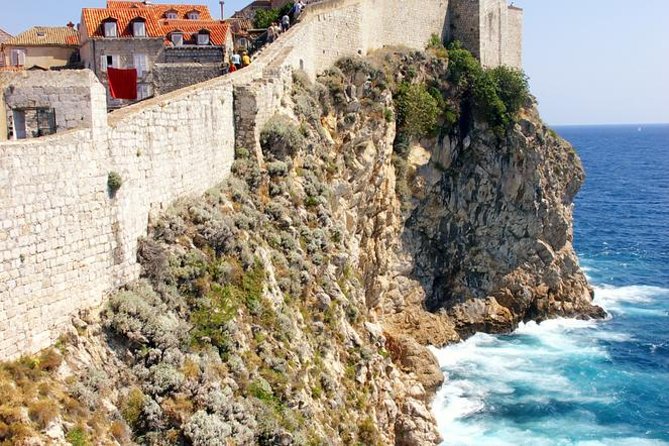
Dubrovnik’s city walls give you the best high-level view of the Old Town, but the stones make more sense when someone explains why they were built. This two-hour walk combines the 1.2-mile circuit with stories of sieges, diplomacy, the Ottoman and Venetian powers, and Dubrovnik’s recent war.
I like the way the tour connects the grand views with small details, from salt and sea trade to the role of Minceta Tower and Fort Revelin. I also like the strong local perspective offered by guides such as Davor and Goran, including personal insight into Croatia’s 20th-century war. The main drawback is plain: the walls require many stairs, and summer heat can make the walk hard work.
Key points to know before booking

- The city walls are the main event: You walk about 2 kilometers with wide views over the Adriatic, Old Town, and port.
- The guide adds the meaning: Davor, Goran, Mara, Andrea, and other local guides explain the forts, sieges, politics, and war.
- The wall ticket costs extra: The tour price is $30.23, but the mandatory entrance fee is listed as €40 for adults in one place and €35 in the practical notes. Check the current price before booking.
- Expect stairs and sun: There are steep climbs, limited shade, and no regular restroom stops.
- Timing matters: An early morning or 6 p.m. departure can be more comfortable than the middle of a hot day.
- The group can be sizeable: The maximum is 35 people, though some departures may be much smaller.
Why Dubrovnik’s walls are worth seeing with a guide
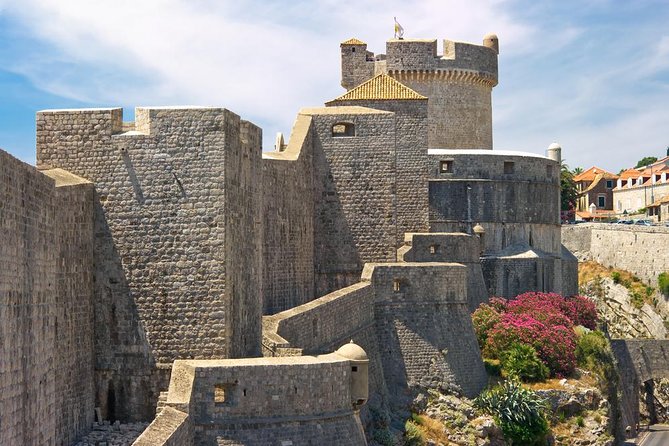
You can walk the walls on your own, but a guide changes what you notice. Without context, the circuit can become a scenic parade of towers and rooftops. With the right explanation, each bastion shows how Dubrovnik protected itself and kept its independence for centuries.
The city began as a settlement separated from the mainland by a sea channel. In the 11th century, that channel was filled in, creating the ground plan of the present Old Town. Defensive walls developed and were strengthened over time, with major work in the medieval period and later repairs that kept their original form.
That story matters because Dubrovnik was not simply a pretty port. It was a small maritime republic positioned between larger and often threatening powers. It used walls, ships, trade, negotiation, and careful diplomacy to survive between Venetian influence and the Ottoman Empire.
I especially value the way this tour links military design with political survival. You do not just hear that a tower is old. You learn why it was placed there, what it guarded, and how the city used defense alongside diplomacy.
More Fortress and Citadel Tours in Croatia
- Dubrovnik: City Walls Early Morning or Sunset Walking Tour
★ 4.8 · 1,523 reviews - Dubrovnik Combo: Old Town & Ancient City Walls
★ 5.0 · 1,019 reviews - Dubrovnik: City Walls, Old Town Walking Tour & Adriatic View
★ 4.9 · 982 reviews
Meeting near Pile Gate and entering the Old Town
The meeting point is the Dubrovnik Walks orange umbrella at Brsalje ul. 8, just outside Pile Gate. Look for the orange marker rather than relying only on the map, since the tour finishes near the old town port, not at the marked meeting point.
Pile Gate is a useful place to start because it puts you directly beside one of Dubrovnik’s main entrances. Your guide greets the group, gives the basic plan, and leads you into the limestone-paved streets of Stari Grad.
The first part is not a long sightseeing circuit through every church and palace. It is a short approach to the city walls entrance. That keeps the tour focused, though you should not book it expecting a full guided tour of every Old Town interior.
The streets are easy to admire, but they can be crowded, particularly when cruise ships are in port. A morning tour gives you a better chance of cooler air and less pressure at the entrance. A late afternoon start can also work well, with one departure ending in time for sunset views.
Walking the 2-kilometer walls
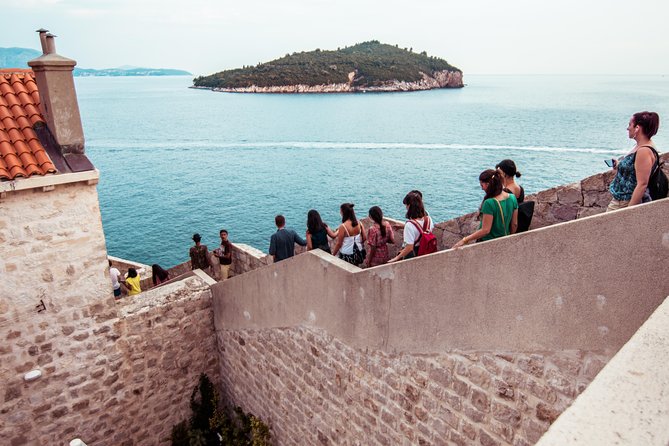
The walls are the heart of the outing. You walk roughly 2 kilometers around the Old Town, climbing stairs and passing defensive towers, open parapets, and changing views over the sea.
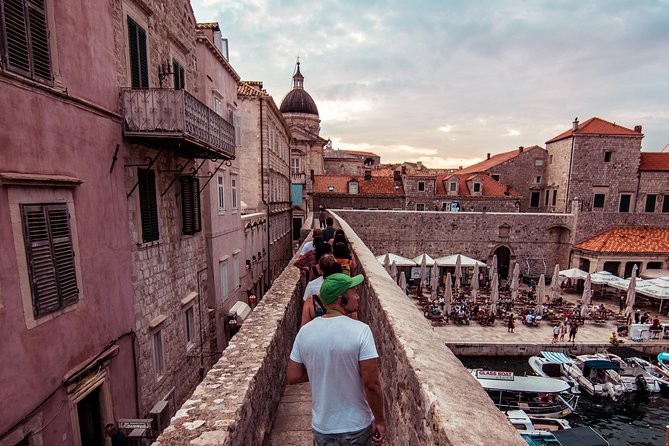
From above, Dubrovnik’s layout becomes clear. You see the dense red roofs inside the walls, the harbor, the Adriatic, and Fort Lovrijenac separated from the main wall complex. The view is a major reason to take the walk, but the guide keeps bringing your attention back to the city below and the defensive choices around you.
The route is not flat. Several climbs are steep, and the stone can feel demanding in hot weather. People who dislike stairs, heights, or prolonged walking should think twice. You need a moderate level of fitness, and comfortable shoes are more important here than stylish ones.
There are some opportunities to pause, buy drinks, and take photographs. Do not count on frequent shade, though. The walls were built for defense, not comfort, and only limited sections offer shelter from the sun. Carry water and consider a hat, especially in summer.
The tour is advertised at about two hours, but the experience includes a long walk and regular explanations. The pace is generally manageable, with stops to look, listen, and take pictures. Still, you should not treat the distance as a casual stroll.
Minceta Tower, Fort Revelin, and Fort Lovrijenac
Minceta Tower is one of the key points on the wall circuit. Its position and height show how Dubrovnik protected the landward side of the city. Your guide explains the tower’s strategic role rather than leaving it as a photo stop.
Fort Revelin gives another view of the city’s defensive planning. Its location helped protect the eastern approach and the harbor area. Looking at these structures from the wall helps you read Dubrovnik as a working fortress, not only as a beautiful old town.
Fort Lovrijenac appears across the water, physically separate from the main walls but belonging to Dubrovnik’s defensive system. The distance makes its position easy to understand. You can visit it after this tour, but that visit is not part of the two-hour walk.
The strongest guides make these forts part of a larger story. They explain how the city faced rivalry, conquest attempts, and pressure from stronger states. The best commentary also shows that independence did not come from stone alone. Dubrovnik survived through trade, negotiation, and knowing when to compromise.
More Fortress and Citadel Tours in Dubrovnik:
- Dubrovnik: Old Town & City Walls Guided Tours Combo
★ 4.8 · 697 reviews - Dubrovnik Cable Car Ride, Old Town Walking Tour plus City Walls
★ 4.5 · 685 reviews - Dubrovnik: City Walls Tour for Early Birds & Sunset Chaser
★ 4.9 · 600 reviews - Dubrovnik City Walls Tour for Early Birds or Sunset Chasers
★ 5.0 · 399 reviews
The war stories and local perspective
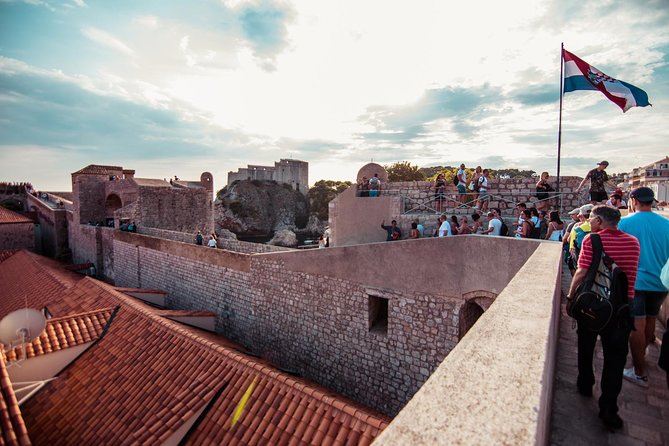
The tour includes Dubrovnik’s more recent wartime history, not only medieval battles. Guides explain the effects of the conflict on the city, and some, including Goran, have personal experience as survivors.
That personal element can make the subject more direct and emotional. It also means the balance of the tour may depend on your guide and the questions asked by the group. One account found the war discussion especially useful but longer than expected. If your main interest is the city’s 1990s experience, this may be a strength. If you mainly want architecture and medieval history, you may prefer a tighter focus.
I appreciate that the war is not treated as a footnote. Dubrovnik’s walls are old, but the city’s defensive story did not end in the Middle Ages. Seeing recent damage and recovery discussed alongside earlier sieges gives the city a more honest identity.
The tour can also touch on Game of Thrones because Dubrovnik is associated with the series. That may interest fans, but it is not the stated purpose of a history and war walk. If you want a dedicated screen-location tour, book a separate one. This experience is better suited to people who want the city’s own story first.
Guides, headsets, and group size
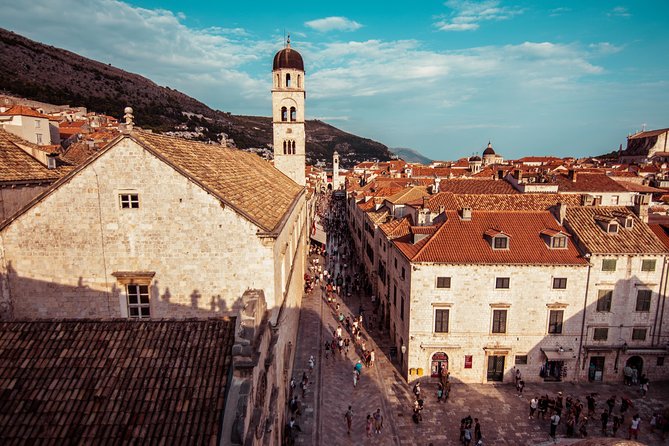
The guide is an English-speaking local expert licensed by the Croatian Ministry of Tourism. Names that have appeared on departures include Davor, Goran, Mara, Andrea, and Devon, with slightly different spellings sometimes used in guest accounts.
Davor receives especially strong praise for clear English, humor, and his ability to explain both Dubrovnik and wider Croatian history. Goran is noted for his personal perspective and entertaining delivery. Mara is praised for handling the demanding wall route well, while Andrea is described as clear and capable of managing crowds and sun.
Individual guide quality can vary, as it does on any scheduled tour. The common thread is that the guide is expected to explain the city rather than simply lead you from one staircase to the next.
Audio headsets are provided for groups of four or more. They can help when the streets are busy or the group stretches along the wall, but headset range may not always be perfect. Stay reasonably close to the guide. If you drift too far ahead or behind, you may lose parts of the explanation.
The maximum group size is 35 people. Some departures have been much smaller, around a dozen people, which makes questions and photographs easier. You should not assume every departure will be intimate.
Price and the extra wall admission
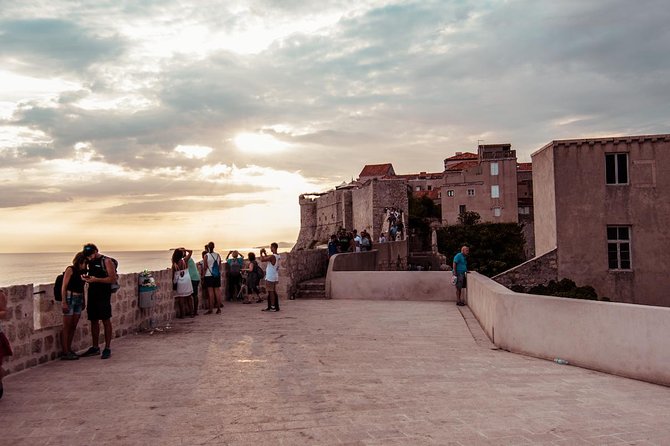
The tour costs $30.23 per person. That is a fair price if you want the city’s history explained while you walk, rather than paying only for access and reading signs yourself.
The important catch is that the City Walls entrance is not included. The information supplied gives two adult prices, €40 in the inclusions section and €35 in the additional notes, with €15 for children aged 7 to 18. Because the amount may change or be presented differently at booking, check the current wall ticket price before you commit.
A Dubrovnik Pass includes one visit to the walls, but it must be purchased and collected in advance. The tour information says the wall ticket can be bought on the spot or paid for with the pass.
Children aged 0 to 11 can join the walking tour free. Children aged 0 to 6 also receive free wall admission, while children aged 7 to 11 do not receive free admission. That distinction matters for families calculating the real cost.
The fee is easier to justify if you care about history, military architecture, and local stories. If you only want the view, walking the walls independently may be enough. If you want to understand why Dubrovnik looks and functions as it does, the guide adds real value.
The practical demands of the route
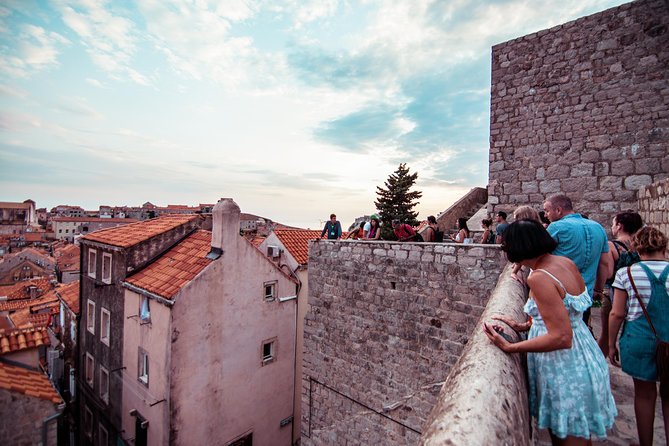
This is not a tour for anyone who wants a relaxed, flat walk. The walls have many stairs, some steep sections, and exposed areas with little shade. Heights may also be uncomfortable for some people.
There are no scheduled restroom stops. One account notes a bathroom opportunity during the route, but you should use facilities before meeting the guide rather than depend on a stop.
Summer conditions deserve serious attention. The Mediterranean heat can build quickly on the stone, and the route has limited shaded areas. I would choose 9 a.m. or around 6 p.m. when possible. A breezy day makes a major difference, while a hot midday departure can turn a pleasant walk into a test of endurance.
The tour is offered in English and requires at least four people to operate. If the minimum is not reached, the provider may offer another date or experience, or a full refund. Poor weather can also lead to a changed date or refund.
Free cancellation is available up to 24 hours before the start time. Changes or cancellations inside that window are not accepted for a refund.
Who should book the Walls and Wars walk?
I would choose this tour if you want Dubrovnik’s famous view but also want the city explained by someone who knows its past firsthand. It suits people interested in architecture, military history, independence, the Adriatic, and Croatia’s recent war.
Families can enjoy it, especially if children respond to stories of forts, sieges, cats, ships, and survival. The stairs and heat are the deciding factors, not the subject matter.
I would be cautious if you have knee, mobility, or balance problems, dislike heights, or struggle in hot sun. The tour is also less suitable if you want a detailed guided visit inside churches, monasteries, and palaces. You see and hear about Old Town landmarks, but the walls remain the main attraction.
Should you book it?
Book it if you want more than a wall ticket and a pretty photograph. The views are excellent, but the strongest part is the explanation of how a small republic used stone, trade, and diplomacy to remain independent. Guides such as Davor and Goran can add a personal connection, especially when discussing the war.
Skip it if the extra wall fee changes the budget, if stairs are a serious concern, or if you prefer to explore at your own pace. For most reasonably fit visitors who want context, I would choose an early morning or 6 p.m. departure, carry water, and take this walk near the start of a Dubrovnik visit.
FAQ
How long does the Dubrovnik Walls and Wars tour last?
The tour lasts approximately two hours.
Where does the tour meet?
Meet at the Dubrovnik Walks orange umbrella at Brsalje ul. 8, near Pile Gate in Dubrovnik.
Where does the tour finish?
The walking portion finishes near the old town port. The map provided for booking shows the meeting point, not the ending point.
Is the City Walls entrance included?
No. The mandatory City Walls entrance fee is separate from the tour price.
How much is the City Walls ticket?
The supplied information lists €40 per adult in one section and €35 per adult in another, with €15 for children aged 7 to 18. Check the current price before booking.
Can I use the Dubrovnik Pass?
Yes. The Dubrovnik Pass covers one visit to the City Walls, but you must purchase and collect it in advance.
Is the tour conducted in English?
Yes. The tour is conducted in English by a local expert guide.
Are children allowed?
Yes. Children aged 0 to 11 can join the tour free. Children aged 0 to 6 also receive free wall admission, while children aged 7 to 11 still need a paid wall ticket.
Is the tour suitable for people who do not like stairs?
No. The route includes many stairs and steep sections, so it is not recommended if stairs are a problem.
What happens if the weather is poor or the tour minimum is not reached?
The provider may offer another date or experience, or a full refund. Free cancellation is also available up to 24 hours before the scheduled start.
More Walking Tours in Dubrovnik
- Dubrovnik: Old Town & City Walls Private Walking Tour
★ 5.0 · 206 reviews - Dubrovnik City Walls Walking Tour
★ 4.9 · 22 reviews - Dubrovnik: Game of Thrones and City Walls Walking Tour
★ 4.8 · 20 reviews - Dubrovnik: City Walls, Stradun & Old Town Story Walking Tour
★ 4.8 · 17 reviews
Just added around Dubrovnik
- Dubrovnik: City Walls Private Guided Walking Tour★ 5.0 · 6 reviews
- Dubrovnik: Game of Thrones & City Walls Walking Tour★ 5.0 · 12 reviews
- Dubrovnik: Sunset Tour With Panorama Of City Walls★ 5.0 · 6 reviews
- Dubrovnik:City Walls & Old Town 2 in 1 Walking Tour★ 5.0 · 16 reviews
- Dubrovnik City Walls Walking Tour★ 4.9 · 22 reviews
- Dubrovnik: Old Town & City Walls Private Walking Tour★ 5.0 · 206 reviews
- Dubrovnik: Old Town & City Walls Tour with Optional DU Pass★ 4.8 · 34 reviews
- Dubrovnik: Game of Thrones and City Walls Walking Tour★ 4.8 · 20 reviews
Fortress & Citadel Tours, compared.

Full Day Taj Mahal, Agra Fort & Baby Taj Tour from Delhi by Car
Read our review →
Fort Sumter Admission and Self-Guided Tour with Roundtrip Ferry
Read our review →
Carcassonne: Castle and Ramparts Entry Ticket
Read our review →
Charleston: Fort Sumter Entry Ticket with Roundtrip Ferry
Read our review →
Same Day Taj Mahal, Fort & Baby Taj Tour from Delhi by Car
Read our review →
From Delhi: Taj Mahal and Agra Fort Private Sunrise Tour
Read our review →
Sunrise Taj Mahal, Agra Fort & Baby Taj Tour from Delhi by Car
Read our review →
Salzburg: Hohensalzburg Fortress Admission Ticket
Read our review →Browse the lists this tour appears in