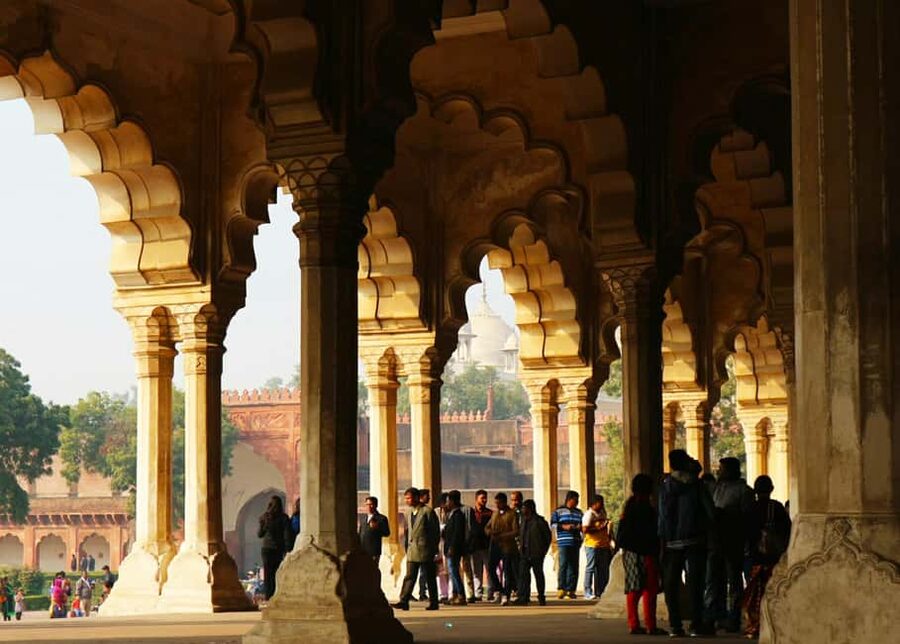
REVIEW · TAJ MAHAL & AGRA FORT TOURS
Agra Fort: Guided UNESCO Heritage Walking Tour
Agra Fort is more than a red sandstone wall near the Taj Mahal. Inside, you move from military defenses to royal courtyards, marble halls, gardens, and the poignant balcony where Shah Jahan spent his final years looking toward the Taj. The fort’s changing mood is what makes this short tour worthwhile.
I like the private format and the guide’s role in bringing meaning to rooms that can otherwise blur together. I also like the practical help: guides such as Shahid Khan and Gagan have been praised for clear meeting instructions, good photographs, crowd navigation, and keeping visitors away from unwanted vendors near the entrance. The main drawback is the one-hour limit. Agra Fort is huge, and you will need to keep moving.
Key points
- Amar Singh Gate is the visitor entrance, with bag checks before you enter.
- See major Mughal spaces, including the Diwan-i-Am, Diwan-i-Khas, Jahangiri Mahal, and Anguri Bagh.
- Pause at Musamman Burj, where Shah Jahan was confined by his son Aurangzeb.
- Look for the Peacock Throne site and hear how the fort served both court and battlefield needs.
- Ask about the mirrored palace, which may be accessible during your visit.
- Pair it with the Taj Mahal, only 2.5 kilometers away, for a strong same-day plan.
Why Agra Fort deserves time beyond the Taj Mahal

Many people come to Agra with one monument in mind. The Taj Mahal gets the famous photograph, but Agra Fort gives you the political story behind it. This was a working imperial center, not simply a palace built for display.
Akbar began shaping the fort in red sandstone, and later rulers, including Jahangir and Shah Jahan, added or changed sections. As you walk, you can see the architecture shift from stern military strength to delicate marble decoration. Rajput, Persian, and Islamic influences meet in arches, balconies, carved screens, and formal garden layouts.
I find that a guide matters here because the fort does not explain every detail in a way that makes the place easy to follow. A good guide helps you understand why a plain-looking courtyard mattered, who stood in a particular hall, and how the fort balanced defense with ceremony.
The tour is offered as a private group experience, so you can ask questions and set a comfortable pace within the one-hour schedule. That is especially useful if you are visiting Agra for only a day and want clear explanations without joining a large group.
More Fortress and Citadel Tours in Agra
- Agra: Skip-the-Line Taj Mahal & Agra Fort Private Tour
★ 4.9 · 1,546 reviews - Taj Mahal, Agra Fort, Baby Taj & Mehtab Bagh Private City Tour
★ 5.0 · 391 reviews - Skip the line with Private Tour Guide for Taj Mahal & Agra Fort
★ 5.0 · 236 reviews
Starting at Amar Singh Gate
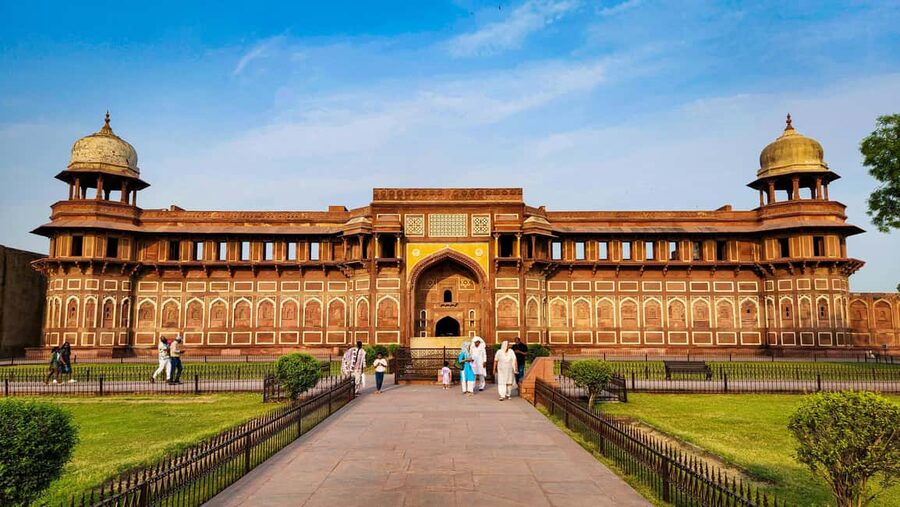
Visitors enter through Amar Singh Gate, the sole entry point used for this visit. The approach gives you an immediate sense of the fort’s defensive purpose, with heavy walls and a layout designed to control movement.
Expect a security check. Large bags and prohibited items are not allowed, and drones and tripods are usually prohibited unless you have special permission. Carry only what you need, and keep your camera or phone ready for permitted photographs.
The entrance area can be confusing, particularly when other vendors and photographers are trying to get your attention. Clear instructions from the local guide can save time here. Gagan has been praised for explaining exactly where and when to meet, while also helping visitors avoid unwanted approaches around the entrance.
Your guide’s contact details are sent by WhatsApp, or by email if you do not use WhatsApp, one day before the tour. The booking voucher also includes the provider’s WhatsApp number. Save those details before leaving your hotel, since transfers are not included and you must make your own way to the fort.
Seeing a fort that was also a royal home
Agra Fort was built to protect the Mughal court, but its interiors remind you that emperors also lived, governed, entertained, and held formal ceremonies here. That dual role gives the tour its shape.
Your guide should point out how the fort’s walls, gates, and controlled passages served military needs. Then the route moves toward courtyards and halls where the decoration becomes more refined. Look for Mughal arches, carved marble, jharokhas, and details that combine Indian and Islamic design.
The change is easy to miss if you rush through taking photographs. I would listen first, then photograph the features your guide identifies. In a place with so many rooms, a short explanation can turn a decorative window into evidence of how royal women, courtiers, or rulers used the space.
The fort is large, and surfaces are uneven. Comfortable shoes are essential, not optional. Even with a private guide, one hour gives you a focused introduction rather than a complete survey.
Diwan-i-Am, where the emperor met the public
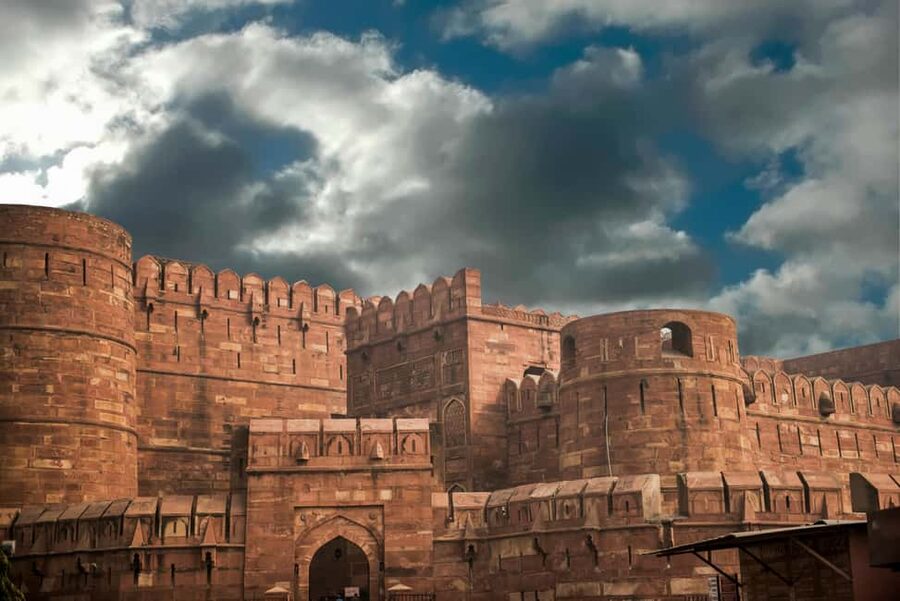
The Diwan-i-Am, or Hall of Public Audience, shows the official side of Mughal rule. This is where the emperor addressed subjects and heard petitions in a formal setting.
The hall’s repeated pillars and open arrangement help you picture a carefully managed public ceremony. Your guide can explain the difference between a space meant for public business and the more restricted areas deeper inside the fort.
This is one of the places where a short guided visit earns its low price. You can walk through the hall on your own, but it is harder to understand its purpose from the architecture alone. The guide gives the room a role in the larger story of imperial government.
Do not expect a long lecture. The best use of this stop is a compact explanation, a look at the structure, and a few minutes to notice how the hall frames the surrounding courtyards.
More Fortress and Citadel Tours in India
- Agra: Premier Tour of Taj Mahal & Agra Fort All Inclusive
★ 4.7 · 173 reviews - Same Day Taj Mahal, Agra Fort & Baby Taj Tour from Jaipur
★ 4.9 · 129 reviews - Agra: Skip the Line Taj Mahal and Agra Fort Private Tour
★ 5.0 · 123 reviews - Agra fort, Baby Taj & Mehtab Bagh Express Ticket With Option
★ 4.9 · 106 reviews
Diwan-i-Khas and the Peacock Throne connection
The Diwan-i-Khas, or Hall of Private Audience, was reserved for more select meetings. This was a setting for dignitaries, court business, and displays of imperial power.
One of the most interesting details connected with the fort is the spot where the Peacock Throne once dazzled onlookers. The throne itself is no longer there, so you will need your guide to explain what occupied this space and why it mattered.
That absence is part of the lesson. Mughal wealth was not just shown through buildings. It was also displayed through movable objects, court ceremony, and the controlled access granted to different ranks of people.
I like this stop because it helps you compare two kinds of authority. The Diwan-i-Am presented the emperor before a wider public. The Diwan-i-Khas created a more private stage for power. With limited time, that contrast is worth paying attention to.
Jahangiri Mahal and the meeting of styles
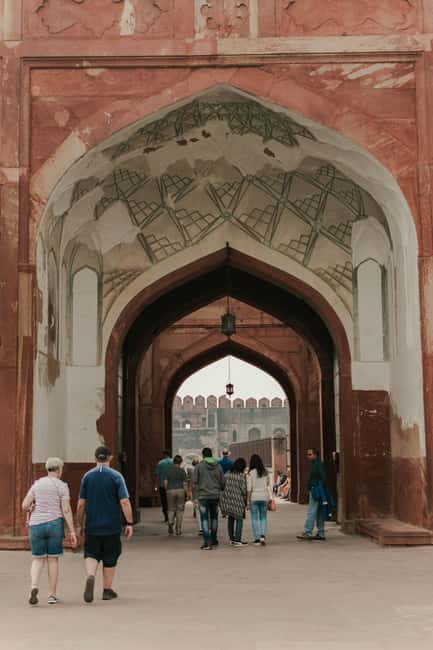
Jahangiri Mahal is one of the fort’s key palace buildings. It reflects the blend of Rajput, Persian, and Islamic design that developed under the Mughal rulers.
Look for the balance between strong sandstone construction and more graceful decorative features. Jharokhas, arches, and carved surfaces give the palace a different character from the outer defenses. Your guide can help you see how local building traditions sit alongside Persian and Islamic elements.
The name links the building with Jahangir, one of the rulers associated with the fort. That connection makes the palace more than a pretty stop. It helps you picture the fort as a succession of royal projects, altered and expanded as rulers changed.
The palace can also be a good place to slow down for photographs. Still, your guide may need to keep the group moving to cover the other important sections within an hour.
Musamman Burj and Shah Jahan’s final view
Musamman Burj is the emotional center of the tour. According to the well-known story connected with the fort, Shah Jahan was confined here by his son Aurangzeb during the final years of his life.
From this part of the fort, you can look toward the Taj Mahal. That view adds a bittersweet note to the visit. Shah Jahan is closely linked with the Taj, yet his final years were spent under confinement, looking toward the monument from Agra Fort.
The exact quality of the view depends on conditions and access on the day, but the connection is clear and powerful. This is a good moment to stop taking pictures for a minute and consider the relationship between the two monuments.
Guides who know the best viewing spots can also help you frame photographs. Shahid Khan has been praised for taking pictures at strong vantage points, which can be useful if you are traveling without someone to hold the camera.
The mirrored palace and Anguri Bagh
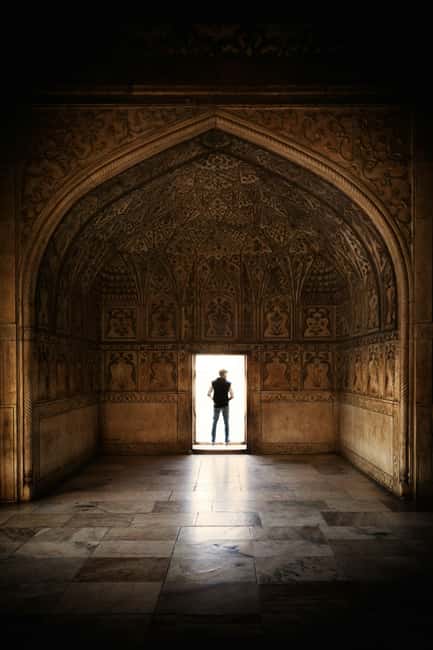
If access allows, the mirrored palace adds a very different experience to the heavy stone and open courtyards. Its reflective decoration catches light and creates a more intimate royal interior.
Access is not guaranteed, so treat it as an opportunity rather than the main reason to book. Ask your guide about current access when you meet. If you cannot enter, the fort still offers plenty to see in the accessible halls and outdoor spaces.
Anguri Bagh provides another change of pace. Its geometric garden design reflects the Mughal love of ordered planting, symmetry, and controlled views. The name refers to grapes, and the garden was once enjoyed by Mughal queens.
The garden is especially useful for photographs because its lines and layout create a clear contrast with the fort’s walls and palace buildings. It also helps explain that royal life here was not only about court audiences and security. Gardens offered a more private setting within the larger complex.
What one hour really allows
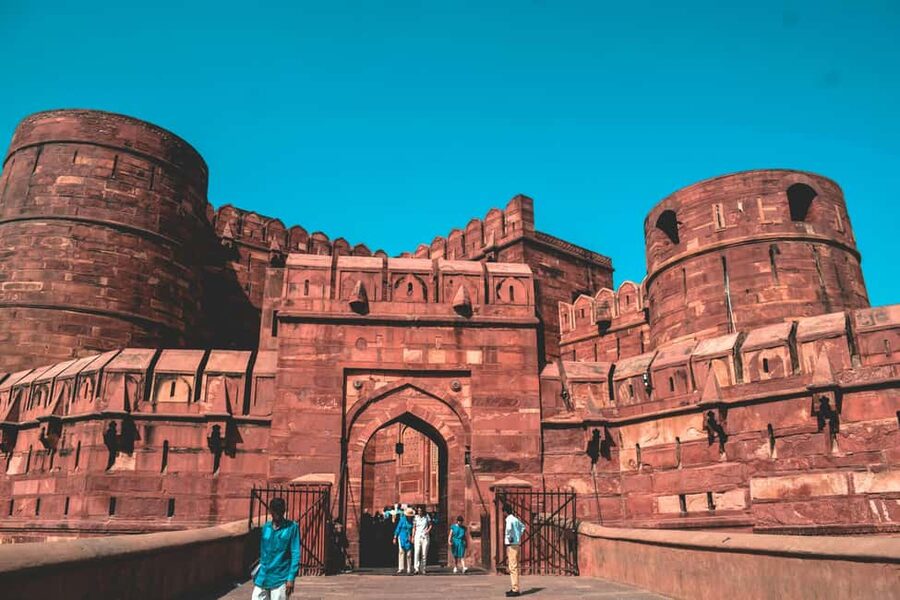
One hour is enough for a well-organized introduction, but it is not enough to inspect every corner of Agra Fort. You will likely focus on the principal halls, palace areas, view toward the Taj Mahal, mirrored palace if open, and Anguri Bagh.
That time limit can be a benefit if you are combining Agra Fort with the Taj Mahal, which is about 2.5 kilometers away. It keeps the visit focused and leaves room for the city’s other major sight. If you want extensive time for architecture and photography, you may find the pace brisk.
A private group gives you more control than a large shared tour. You can ask for a little extra time at a place that matters to you, though the route still needs to fit the scheduled hour.
The guide’s pace has received strong praise. One guide was described as patient and willing to wait when a visitor arrived very late. That does not mean lateness is a good plan, but it does suggest that communication and personal attention are part of the experience.
Price, value, and practical planning
At $6 per person, this is an inexpensive way to add context to one of India’s most important historic sites. The price covers the guided tour, not transfers, so you must arrange your own transport to Amar Singh Gate.
The value depends on what you want. If you mainly need an escort through the entrance, you can manage without a guide. If you want the halls, gardens, royal stories, and Taj Mahal viewpoint to connect into one clear visit, the fee is easy to justify.
English and Hindi are the available tour languages. The group is private, which makes the price particularly appealing for couples, families, or small groups who want direct access to a guide without joining strangers.
Book with the schedule in mind. Free cancellation is available up to 24 hours before the tour for a full refund, and you can reserve now and pay later. The start time varies, so check availability before building your Taj Mahal plan.
Who will enjoy this Agra Fort walk
I would recommend this tour to first-time visitors who want the main story without spending half a day inside the fort. It also suits anyone who appreciates practical help with photographs, entrance arrangements, and avoiding the distractions around the gate.
Families and older visitors should consider the uneven ground and amount of walking. Comfortable shoes will make a real difference. The private format also helps if one person in your group needs a slower pace, although the one-hour schedule limits how slowly you can move.
History fans may want longer than one hour. This tour gives you the important names and places, but it cannot cover every courtyard, building, and architectural detail. You can still use it as a strong orientation before exploring a little on your own, if time and access allow.
Should you book this Agra Fort tour?
Book it if you want a low-cost, focused introduction to Agra Fort and value having a guide explain what you are seeing. The strongest reasons are the private format, the clear focus on major Mughal buildings, the Musamman Burj view toward the Taj Mahal, and the practical help offered by guides such as Shahid Khan and Gagan.
Skip it if you prefer to wander alone, want a slow architectural study, or already have a guide for your full Agra visit. For most short stays, though, $6 is a sensible price for one hour of useful context at a very important monument.
FAQ
Where does the Agra Fort tour begin?
The visit begins at Amar Singh Gate, the sole entry point used for visitors on this tour.
How long does the tour last?
The guided tour lasts one hour.
What is included in the price?
The price includes a guided tour of Agra Fort.
Are transfers included?
No. Transfers are not included, so you must arrange your own transportation to the meeting point.
Which languages are available?
The live guide is available in English and Hindi.
Is this a private tour?
Yes. The experience is offered for a private group.
Which parts of Agra Fort will I see?
The tour includes the Diwan-i-Am, Diwan-i-Khas, Jahangiri Mahal, Musamman Burj, and Anguri Bagh. The mirrored palace may be accessible during your visit.
Can I take photographs?
Photography is allowed. Drones and tripods are usually prohibited unless you have special permission.
What should I bring?
Bring comfortable shoes for uneven surfaces and walking, along with a camera if you want photographs.
How close is Agra Fort to the Taj Mahal?
The Taj Mahal is about 2.5 kilometers from Agra Fort, making it possible to plan both monuments on the same day.
More History Tours in Agra
- Historical Agra Day Tour: Taj Mahal Sunrise, Agra Fort and Baby Taj
★ 5.0 · 4 reviews - Edinburgh: Edinburgh Castle Guided History Tour with Tickets
★ 4.8 · 9,933 reviews - Charleston historical walking tour with a Professor of History at The Citadel
★ 5.0 · 1,284 reviews - Buda Castle District Dark History, Legends and Vampire Night Tour
★ 4.5 · 1,240 reviews
More Taj Mahal and Agra Fort Tours in Agra
- Agra: Taj Mahal Skip-The-Line, Agra Fort & Baby Taj Tour
★ 4.8 · 86 reviews - Agra: Guided Tour of Taj Mahal, Agra Fort and Fatehpur Sikri
★ 4.7 · 81 reviews - From Agra – Skip the Line: Taj Mahal & Agra Fort Tour by Car
★ 5.0 · 74 reviews - Agra: Taj Mahal, Agra Fort & Baby Taj Guided Day Tour
★ 5.0 · 71 reviews
Just added around Agra
- Private Tour Guide For Taj Mahal And Agra Fort★ 5.0 · 17 reviews
- Taj Mahal & Agra Fort Tour with Fatehpur Sikri from Agra★ 5.0 · 13 reviews
- Taj Mahal & Agra Fort Tour from Agra City★ 5.0 · 30 reviews
- Taj with mausoleum and Agra fort visits : Choose Your Option★ 4.5 · 57 reviews
- From Agra: Skip-the-Line Taj Mahal & Agra Fort Private Day Tour★ 5.0 · 25 reviews
- Taj Mahal and Agra Fort Private Tour by Car from Delhi★ 5.0 · 13 reviews
- Taj Mahal & Agra Fort Skip-the-Line Tour from Delhi or Agra★ 5.0 · 47 reviews
- Skip the line Taj Mahal and Agra Fort private Tour by Car★ 5.0 · 6 reviews
Taj Mahal & Agra Fort Tours, compared.

Full Day Taj Mahal, Agra Fort & Baby Taj Tour from Delhi by Car
Read our review →
Same Day Taj Mahal, Fort & Baby Taj Tour from Delhi by Car
Read our review →
From Delhi: Taj Mahal and Agra Fort Private Sunrise Tour
Read our review →
Sunrise Taj Mahal, Agra Fort & Baby Taj Tour from Delhi by Car
Read our review →
From Delhi: Taj Mahal Sunrise, Baby Taj & Agra Fort Day Tour
Read our review →
Agra: Skip-the-Line Taj Mahal & Agra Fort Private Tour
Read our review →
Taj Mahal, Agra Fort, Baby Taj Tour from Delhi by Superfast Train
Read our review →