
REVIEW · WALKING TOURS
Buda Castle Private Walking Tour: A Kingdom of Many Nations
Buda Castle Hill is where Budapest’s royal story gets its best setting. This private walk connects the palace, Matthias Church, Fisherman’s Bastion, Sándor Palace, and Vienna Gate, with an historian guide explaining how one hill passed from medieval kings to Ottoman pashas and Habsburg rulers. I like the private format and the way the tour links grand events to small details in the old streets. I also like having a choice of morning or afternoon departure.
The main drawback is that the title may suggest a visit to a complete medieval castle interior. What you see today is a rebuilt palace complex and a hilltop district shaped by many reconstructions, while entry tickets for Matthias Church and Fisherman’s Bastion cost extra. Guides named Kata and Julia have been associated with especially strong, detailed explanations, but your assigned guide may differ.
Key points at a glance
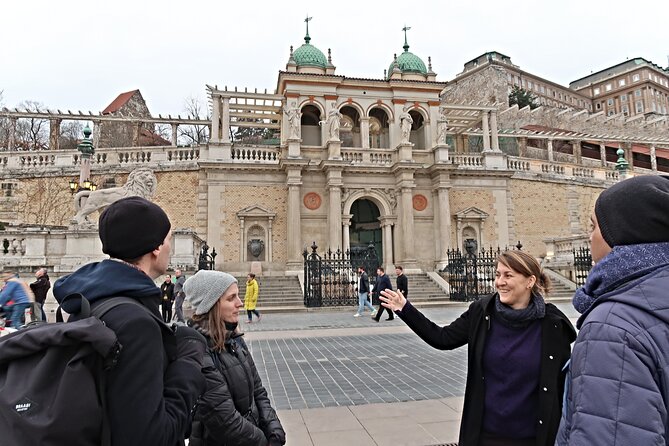
- A private historian-led walk: Your guide can focus on your interests instead of following a large group’s pace.
- Castle Hill in one compact route: The walk includes the royal palace area, Sándor Palace, Matthias Church, Fisherman’s Bastion, and Vienna Gate.
- History with several turning points: You hear about King Béla IV, King Matthias, Ottoman rule, Habsburg power, and postwar rebuilding.
- The Danube panorama is part of the experience: Fisherman’s Bastion gives broad views toward Pest, Margaret Island, and Gellért Hill.
- Tickets are extra: Matthias Church and Fisherman’s Bastion admission are not included, and food and drinks are also on your own.
- A practical meeting point: Unless hotel pickup is arranged, meet at Bálthazár café on Országh utca 31, 15 minutes before departure.
Why Castle Hill works so well for a private walk
Budapest can feel like two cities divided by the Danube, and Castle Hill lets you read that division from above. Buda rises on the western side, with its old royal quarter and winding streets. Pest spreads across the river, with the Parliament building, Margaret Island, and the distant hills helping you place the city on a map.
I like this tour because it is not just a parade of pretty buildings. The guide has three hours to explain why the hill mattered, why its buildings look older or newer than they seem, and how wars and political change kept altering the site. You get the architecture, but you also get the reason behind it.
The private setup matters most for history lovers. If you want to ask how Ottoman rule changed the city, why King Matthias mattered, or why the palace has an eclectic appearance, you can stop and ask. With a larger group, those questions often get lost.
The group size needs a small note of caution. The information describes a maximum of eight people per booking and up to ten travelers overall. Those figures do not match perfectly, so I would confirm the final party size when booking. Either way, this is intended to be a small, personal walk rather than a coach excursion.
More Walking Tours in Budapest:
- Budapest: Buda Castle Walk with Saint Stephen’s Hall
★ 4.5 · 3,012 reviews - Budapest: Buda Castle District Walking Tour
★ 4.6 · 2,108 reviews - Budapest: 3-Hour Grand City Tour and Castle Walk
★ 4.3 · 1,437 reviews
Beginning near Bécsi kapu tér
Unless you arrange hotel pickup, you meet your guide at Bálthazár, a hotel with a café at Országh utca 31. It is about 50 meters from the first bus stop on Castle Hill, at Bécsi kapu tér. Arrive 15 minutes early, since the walk starts from the hilltop rather than from downtown Budapest.
That location is useful if you are already visiting Castle Hill or using public transportation. Pickup is offered, but it is not automatic, so do not assume someone will collect you from your hotel. The confirmed meeting details should be clear after booking.
The route takes place on narrow, cobbled streets. You should be ready for a steady walking tour rather than a seated sightseeing experience. The information says most people can participate, but it does not promise a completely step-free route or describe specific mobility arrangements. If that matters to you, ask before reserving.
The royal palace and the many lives of Buda Castle
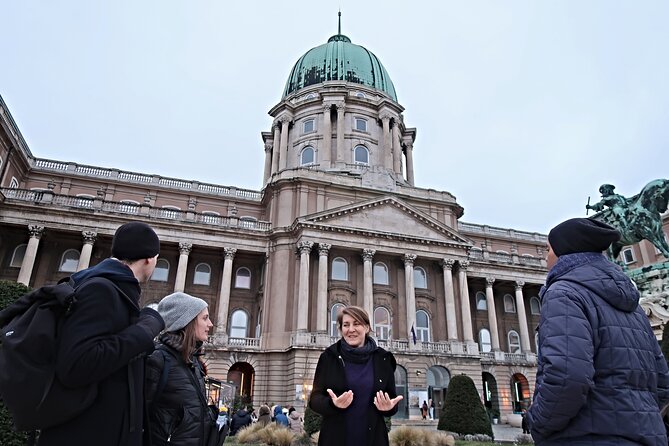
The walk begins around the palace at the southern tip of Castle Hill. The building is massive, formal, and much more complicated than its present appearance suggests. It has been rebuilt, enlarged, altered, burned, and rebuilt again, which explains why the palace does not present one clean medieval style.
The first fortress here was built around 1250 by King Béla IV after Mongol forces devastated the region. That origin gives the hill its first major role: a defensive stronghold above the river. Later, King Matthias turned Buda into a leading Renaissance court in the late 15th century.
Then the story changes direction. Ottoman pashas ruled Hungary for more than 150 years, followed by Habsburg emperors. Each period changed the use and appearance of the hill. Your guide discusses the building’s changing function, which is one of the most useful parts of the tour because it keeps you from treating the palace as a single untouched royal residence.
The palace you see now gained its eclectic appearance largely through rebuilding after World War II. That point is important for setting expectations. Buda Castle is not a perfectly preserved medieval fortress, and parts of the complex may disappoint anyone expecting a complete royal interior from the Middle Ages. The value here is in understanding the layers of construction and political power, not in seeing one original castle frozen in time.
The itinerary gives two hours to Buda Castle and the surrounding hill, then another 15 minutes specifically to the palace and its changing role. These entries appear to overlap, so treat the timing as a guide rather than a strict schedule. Your actual pace may depend on questions, ticket lines, and how much time your guide spends on the palace district.
Sándor Palace and Hungary’s modern state

A short stop at Sándor Palace adds a modern political note to the royal setting. Built in Neoclassical style in 1806 for Count Vincent Sándor, an aristocrat and philosopher of the Austro-Hungarian Empire, the building now serves as the official residence of Hungary’s president and the seat of the Office of the President.
The stop lasts about five minutes, so do not expect a full interior visit. Its value is visual and historical. You see how a former aristocratic residence became part of the modern state, and you get another example of the hill’s changing function.
I appreciate this kind of brief stop because it prevents the walk from becoming an endless procession of medieval subjects. Castle Hill is not only about kings and sieges. It still has a role in present-day government.
More Private Tours in Budapest:
- Private photography photo session at Fisherman Bastion
★ 5.0 · 269 reviews - Budapest: Buda Castle Private Walking Tour
★ 4.9 · 46 reviews - Buda Castle: Private Walking Tour
★ 4.2 · 23 reviews - Budapest: Fast Private Photoshoot at Fisherman’s Bastion
★ 5.0 · 14 reviews
Matthias Church, bright tiles and a Gothic revival
Matthias Church is likely to be one of the visual highlights. Its patterned roof is easy to spot among the surrounding buildings, and the interior is described as highly decorated. The church is a late 19th-century Neogothic reconstruction, not a simple untouched medieval survivor.
That distinction makes the building more interesting, not less. You can admire the Gothic appearance while learning that much of what you see was rebuilt as a carefully designed historical vision. The result is striking, but it reflects the 19th century’s idea of the medieval past as much as the Middle Ages themselves.
The planned visit lasts about 20 minutes. Admission is not included, so you pay separately if you want to enter. Since the walk is built around the church as an important stop, I would check the current ticket arrangement before setting out and budget extra time if you want more than a quick look.
This is also where a private guide can help. A guide such as Kata or Julia may explain the difference between original medieval fabric and later reconstruction, then adjust the discussion if you care more about architecture, religion, royal ceremonies, or wartime damage. The listed experience specifically promises an historian guide, so the church is not treated only as a photo stop.
Fisherman’s Bastion and the big Budapest view
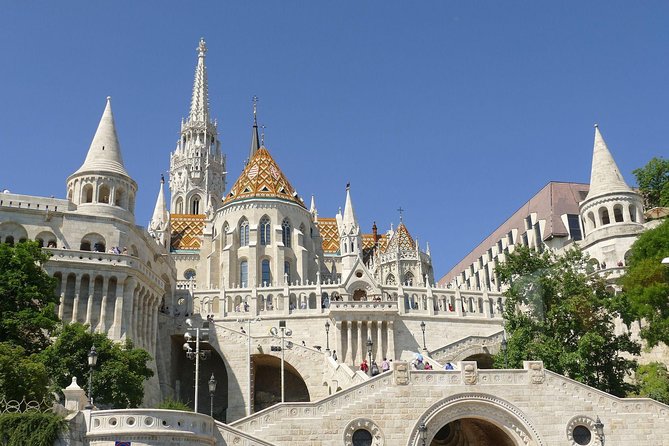
Fisherman’s Bastion is a viewing terrace designed in Neo-Gothic and Neo-Romanesque styles between 1895 and 1902. Its seven towers represent the seven Magyar tribes traditionally associated with the settlement of the Carpathian Basin at the end of the ninth century.
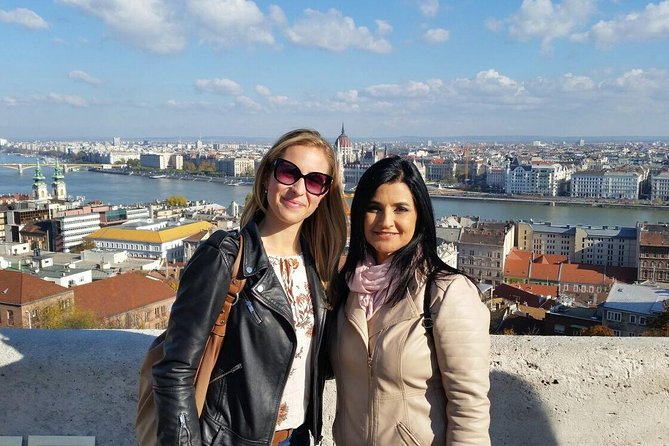
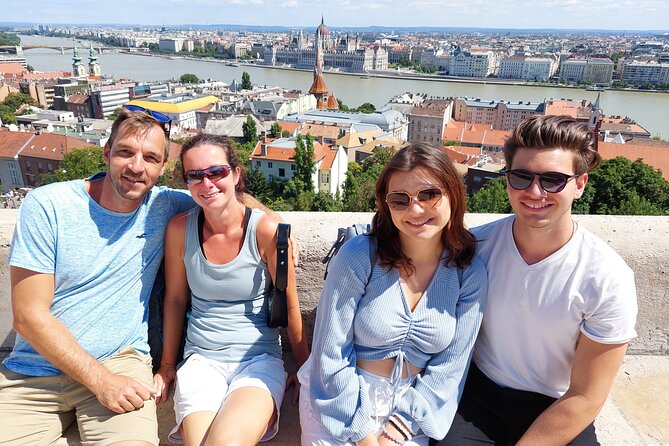
The terrace gives you the classic high view across the Danube. You can look toward Pest, Margaret Island, and Gellért Hill, with the river tying the city together below. This is the place to pause, take photographs, and let the geography make sense.
Admission is not included here either. The itinerary allows about 20 minutes, but a ticket may be needed for certain terrace areas. Your guide can show you the setting, but you should expect an additional charge if you want the ticketed access.
There is also a useful lesson in the building itself. Fisherman’s Bastion looks convincingly medieval, yet it is a late 19th-century creation. Along with Matthias Church and the rebuilt palace, it reinforces the main theme of the walk: Castle Hill is full of historical references, but not everything that looks old is an original medieval structure.
Vienna Gate and a view toward Roman Aquincum
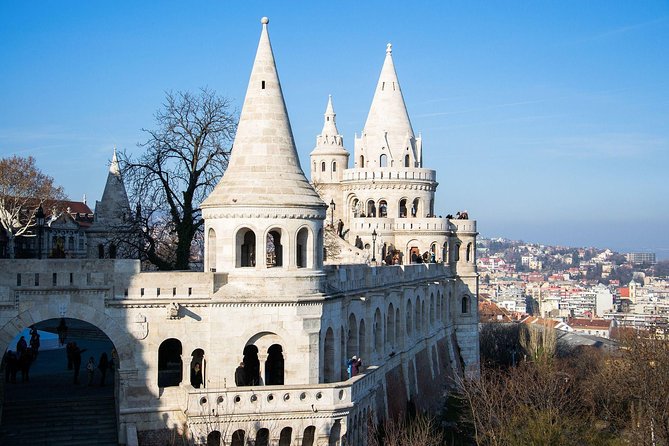
The final stop is Vienna Gate, where the walk ends. From here, you can see toward Óbuda, or Old Buda, the area where the Romans founded Aquincum.
This ending shifts the story beyond royal Buda. The city’s past reaches back before the medieval kingdom, and the view helps you picture the wider settlement rather than only the palace district. It also gives you a clear endpoint after the church and bastion, instead of leaving you in the middle of the hill.
The tour does not include a return transfer. Once you reach Vienna Gate, you are on your own, so plan your next move before the walk begins. The end point is still in Budapest, but it is not the same as the starting café.
What the three-hour timing really means

Three hours is a good length for this route if you want history without giving up an entire day. You have enough time for the main buildings, the views, and questions, but the experience is still focused.
The published stop times add up to more than three hours if read separately. The two Buda Castle entries clearly overlap, since one covers the broader Castle Hill area and another focuses on the palace. Use the schedule as a rough outline, not a promise that every stop receives its exact listed minutes.
Morning and afternoon departures give you useful flexibility. A morning walk may fit well before a museum or lunch elsewhere. An afternoon departure lets you spend the first half of the day at another Budapest sight and come to Castle Hill later. The information does not promise a particular light level, crowd level, or sunset view, so choose the time that fits your day rather than assuming one departure is always best.
Is $397.36 a fair price?
The price is $397.36 per group, with the stated capacity reaching up to ten people. At ten people, that works out to about $39.74 each. At eight people, it is about $49.67 each. For a couple, however, the full group price becomes much harder to justify.
The value comes from the private historian guide, not from included admissions. Matthias Church and Fisherman’s Bastion tickets are extra, and no food or drinks are provided. You are paying for focused attention, a tailored explanation, and the ability to ask questions as you go.
I would consider it good value for a family or group of friends who want one guide for the whole party. It is less attractive for one or two people who prefer to explore at their own pace or who do not care for detailed historical commentary. If you are comparing it with a cheaper group walk, ask yourself how much you value privacy and flexibility.
The strong praise attached to guides such as Kata and Julia points to the most important part of the purchase: the person leading the walk. The tour works best when your guide brings the palace’s changes, the church’s reconstruction, and the city’s political history together in a clear way.
Who should book this Castle Hill experience?
I would choose this tour if you want context rather than a quick checklist of sights. It suits first-time visitors who want to understand Buda, history-minded couples, families with older children, and small groups who prefer to ask questions freely.
It is also a good fit if you are unsure how to read the hill’s mixture of medieval references, 19th-century design, and postwar rebuilding. A guide can help you avoid the common mistake of assuming that every Gothic-looking building is original.
I would skip it if your main goal is a long interior visit, a food experience, or a low-cost introduction to Budapest. The walk is centered on outdoor sightseeing and explanation. You must also pay separately for the church and bastion tickets, and you should not expect the palace to function as a fully preserved medieval castle.
Practical details before you reserve
You receive confirmation within 48 hours, subject to availability. The experience is offered in English and includes a mobile ticket.
Free cancellation is available if you cancel at least 24 hours before the start time. Cancellations or changes made inside that window are not refunded or accepted, and the cut-off follows local Budapest time.
The default meeting point is Bálthazár, Országh utca 31, 1014 Budapest. Meet 15 minutes before the start unless hotel pickup has been arranged. Since the route uses narrow, cobbled streets and the information only says that most people can participate, ask ahead about any specific mobility concern.
Should you book it?
Book this Buda Castle walking tour if you want an informed, private explanation of Budapest’s most layered hilltop district. The best reasons are the historian guide, the chance to ask questions, and the route from the palace to Matthias Church, Fisherman’s Bastion, and Vienna Gate.
Before paying, confirm the final group-size limit, the pickup arrangement, and the separate admission costs. If you expect an intact medieval castle, adjust that expectation. If you want to understand why Buda looks like a mixture of royal palace, Gothic revival, modern government, and postwar reconstruction, this focused three-hour walk makes a strong case for itself.
FAQ
How long is the Buda Castle private walking tour?
The tour lasts approximately three hours.
Where does the tour begin?
Unless hotel pickup has been arranged, you meet at Bálthazár, Országh utca 31, 1014 Budapest. The café is about 50 meters from the first bus stop on Castle Hill at Bécsi kapu tér.
Where does the tour end?
The walk ends at Vienna Gate on Castle Hill.
Is hotel pickup available?
Pickup is offered, but you need to arrange it. Otherwise, use the default meeting point at Bálthazár.
What language is the tour offered in?
The tour is offered in English.
Are admission tickets included?
No. Admission to Matthias Church and Fisherman’s Bastion is not included. Food and drinks are also excluded unless specifically stated.
Is the tour private?
Yes. It includes a private guide, with the listed capacity described as up to ten travelers. The booking information also gives a maximum of eight people per booking, so confirm the final group size when reserving.
What sights are included in the walking route?
The route covers Buda Castle and the surrounding Castle Hill area, Sándor Palace, Matthias Church, Fisherman’s Bastion, and Vienna Gate.
Can I cancel for a full refund?
Yes, if you cancel at least 24 hours before the experience starts. Cancellations or changes made less than 24 hours before the start time are not refunded or accepted.
Just added around Budapest
- Secrets of Buda Castle: Self-Guided Puzzle Adventure in Budapest★ 5.0 · 8 reviews
- Budapest Hike to Visegrád Castle w or wo Sauna/Danube beach★ 5.0 · 11 reviews
- Citadella and Gellert Hill Segway Tour★ 5.0 · 33 reviews
- Castle District tour with Matthias Church Ticket & Cake & Coffee★ 5.0 · 31 reviews
- Buda Castle Tour: History and Architecture★ 5.0 · 33 reviews
- Buda Castle Quarter Walking Tour★ 5.0 · 16 reviews
- Buda Castle’s Secrets with a Historian★ 5.0 · 108 reviews
- Buda Castle Walking Tour with Matthias church entry, Cake&Coffee★ 4.5 · 21 reviews
Walking Tours, compared.

Edinburgh Castle: Guided Walking Tour with Entry Ticket
Read our review →
Prague: 3-Hour Walking Tour of Old Town & Prague Castle
Read our review →Edinburgh Castle: Guided Walking Tour with Entry Ticket
Read our review →
Edinburgh Castle Guided Walking Tour in English
Read our review →
Budapest: Buda Castle Walk with Saint Stephen’s Hall
Read our review →
Prague 3-hour Afternoon Walking Tour including Prague Castle
Read our review →
Dubrovnik: City Walls Early Morning or Sunset Walking Tour
Read our review →Browse the lists this tour appears in