
REVIEW · FORTRESS & CITADEL TOURS
Hue Customizable Tour with Imperial Citadel & Forbidden City
Hue’s Imperial Citadel is easier to understand with someone beside you. The walls, gates, urns, temples, and ruined palace buildings can blur together when you explore alone. A good guide turns them into a story about the Nguyen emperors, court rituals, Confucian order, royal wives, concubines, and eunuchs.
I like the choice between a short guided walk and a longer private-car day. I also like the human touch: guides such as Misa, Nhi, Ha, Nhien, Duy, and Linh are praised for clear English, patience, humor, and a willingness to answer detailed questions. The main catch is simple: your entrance ticket is not included, and the private-car option gives you a driver rather than a licensed tour guide.
Key points at a glance
- Nine Holy Cannons open the walking tour, giving you an immediate link to Gia Long’s early Nguyen dynasty.
- The 2.5-hour route covers the essential royal core, including Noon Gate, Thai Hoa Palace, the Nine Dynastic Urns, temples, and the Forbidden Purple City.
- Misa, Nhi, Ha, Duy, and other local guides explain symbols and customs, not just building names and dates.
- The private car option can be shaped around your interests, from the Imperial City and Thien Mu Pagoda to three emperor tombs and Thuy Tien Abandoned Water Park.
- The $12 starting price is good value for guiding or transport, but you must budget separately for admission, food, drinks, and any extra pickup charge.
- Shade, water, and sensible shoes matter, since much of the citadel visit takes place outdoors in Hue’s heat or rain.
Why a guide changes the Imperial Citadel
Hue’s Imperial City is not just a collection of photogenic gates and old courtyards. It was the political and ceremonial center of the Nguyen dynasty, Vietnam’s last royal dynasty. Without context, you may admire the roofs and painted details but miss why one building faced another, why certain numbers mattered, or why particular animals appeared in the decoration.
A local guide helps connect the physical site to royal life. You learn where emperors were crowned, where ancestral worship took place, and how the Forbidden Purple City once served as the private center for the emperor, queen, lesser wives, concubines, and palace staff.
I especially like the way the best guides handle the information. Misa has been praised for using questions to keep people involved and for explaining the connections between Confucianism, feng shui, Buddhism, architecture, and court ceremony. Nhi is noted for making the Nguyen dynasty easy to follow, while Ha and Nhien are praised for warm conversation as well as solid historical detail.
That personal style matters here. You can ask why a symbol appears on a roof, how the court was organized, or what changed after 1945. You are not left with a list of names to memorize.
More Fortress and Citadel Tours in the world:
- Same Day Taj Mahal, Agra Fort & Baby Taj Tour from Delhi by Car
★ 5.0 · 4,304 reviews - Full Day Taj Mahal, Agra Fort & Baby Taj Tour from Delhi by Car
★ 5.0 · 3,647 reviews - Fort Sumter Admission and Self-Guided Tour with Roundtrip Ferry
★ 4.5 · 3,343 reviews
Starting at the Nine Holy Cannons
For the walking tour, you meet at the four bronze cannons near Ngan Gate, also called Cua Ngan. Your guide holds an A4 sheet with your name. Pay attention to the meeting point because five cannons sit on the opposite side, an easy mistake if you are arriving in a hurry.
The Nine Holy Cannons were cast by Hue artisans in 1803, during the second year of Emperor Gia Long’s reign. They are important works of bronze art and an early reminder that this was a carefully planned imperial capital, not simply a walled military site.
This first stop is brief, around 15 minutes, but it gives your guide a useful starting point. The cannons were originally placed near the entrance to the Imperial City by Ngo Mon Gate and moved to their current position during the reign of Khai Dinh.
The route then moves toward the Flag Tower. The tower occupies the middle of the citadel’s southern side and was used to fly the royal flag. It is a short stop, around five minutes, mainly for photographs and orientation.
Noon Gate and the royal approach
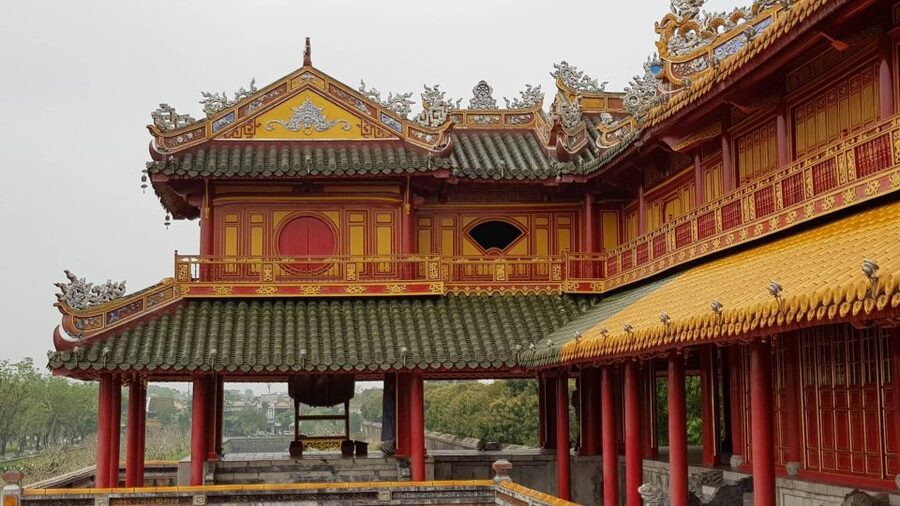
Noon Gate, or Ngo Mon, is one of Hue’s most recognizable structures. Built in 1833 under Emperor Minh Mang, it served as the ceremonial southern entrance to the Imperial City. The gate also had a practical military role, including troop movements and official ceremonies.
This is one of the places where a guide earns the modest tour price quickly. The gate is large and impressive on its own, but the explanation helps you read the space as an expression of royal power and strict court order.
Allow about 15 minutes here. You will have time to take photographs, listen, and look around. The walking route is not a race, but the total visit includes many stops, so your guide will keep the group moving.
Thai Hoa Palace and the heart of royal ceremony
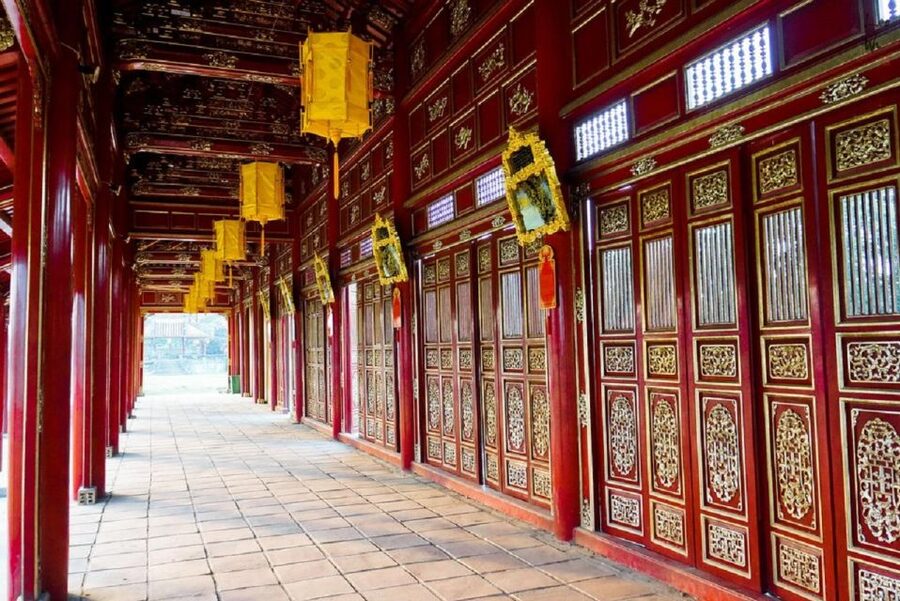
Thai Hoa Palace, or the Palace of Supreme Harmony, was the coronation site for 13 Nguyen emperors, from Gia Long through Bao Dai. In a feudal government, this was considered the center of the country.
The palace is one of the key stops on the tour, with roughly 15 minutes listed for viewing and explanation. Your guide can help you understand the difference between a ceremonial building and a private royal residence. Thai Hoa Palace was about public authority, ceremony, and the emperor’s role at the center of the court.
You then continue through Hien Lam Pavilion and toward the Nine Dynastic Urns. Hien Lam Pavilion forms part of the ceremonial area near The Mieu Temple. The short stop helps place the urns and ancestral temples within the larger royal plan.
More City Tours in the world:
- Potsdam: City and Castles Tour
★ 4.7 · 3,721 reviews - Quebec City: Guided Tour of Fairmont Le Château Frontenac
★ 4.7 · 3,027 reviews - Dublin to Rock of Cashel, Cork City & Blarney Castle Guided Tour
★ 4.5 · 2,536 reviews - Budapest: 3-Hour Grand City Tour and Castle Walk
★ 4.3 · 1,437 reviews
The Nine Dynastic Urns and Nguyen ancestors
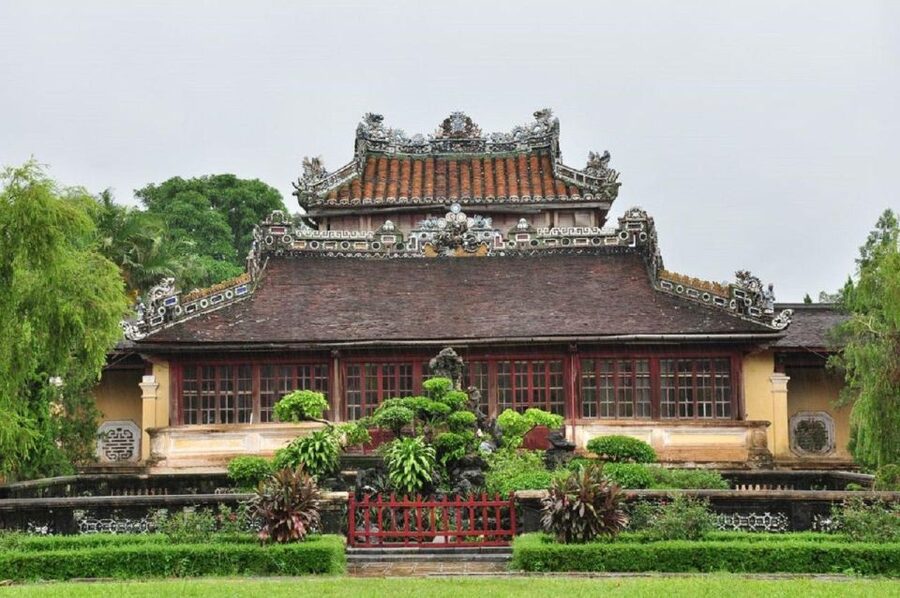
The Nine Dynastic Urns are among the most striking objects in the citadel. Emperor Minh Mang ordered the bronze urns in 1835, and they were completed and inaugurated in 1837. They sit in front of The Mieu Temple.
The urns represent the Nguyen dynasty and its imperial ancestors. Their decoration includes symbolic references to the natural world and the kingdom. This is a good place to pause and ask your guide about the meaning of animals, numbers, and other motifs.
Several people who have taken the walk with children found these explanations especially useful. Symbols give younger visitors something concrete to look for, and they make the history less abstract.
The route also includes Hung To Mieu, Hung Mieu, and Trieu To Mieu. These temple spaces can be easy to skim past if you are alone, especially after seeing the larger gates and palace buildings. A guide explains whom the temples honor and how ancestor worship shaped royal life.
Entering the Forbidden Purple City
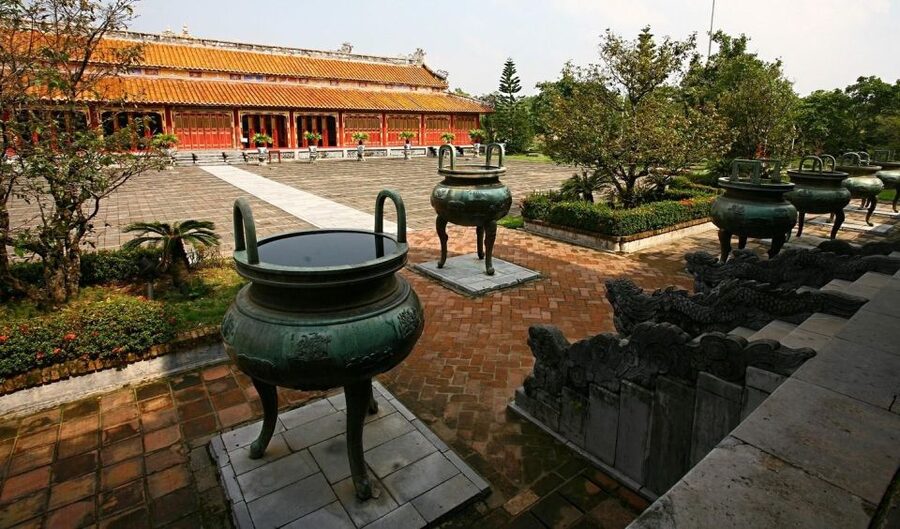
The Forbidden Purple City, or Tu Cam Thanh, was first built by Gia Long in 1804 and renamed during the third year of Minh Mang’s reign in 1822. It stood behind Thai Hoa Palace as the emperor’s private residential and working zone.
This is the emotional center of the walking tour. The name suggests mystery, but the real interest lies in the people who lived and worked here. Your guide discusses the emperor’s household, queens, lesser wives, concubines, eunuchs, and the strict rules that governed access.
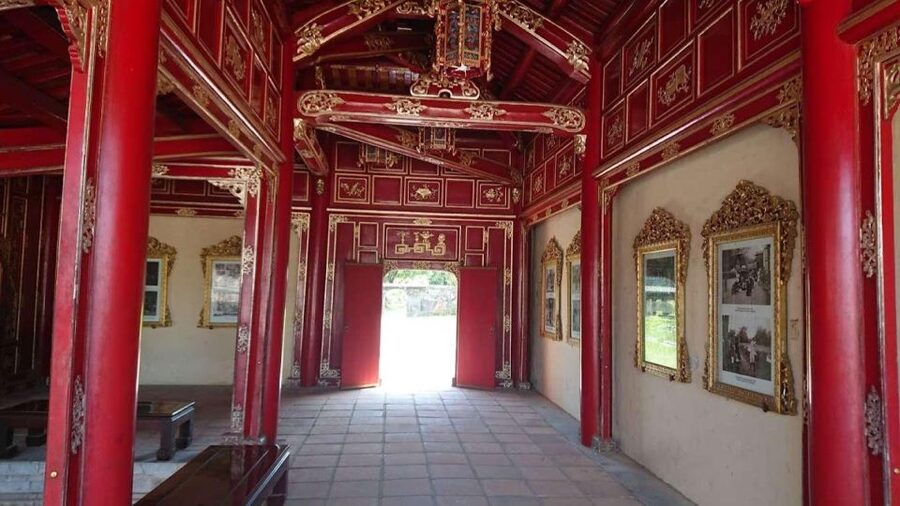
Much of the complex was damaged or lost, so expectations matter. You are not entering a fully preserved palace town. You will see surviving buildings, reconstructed areas, open courtyards, gardens, and traces of a much larger royal compound.
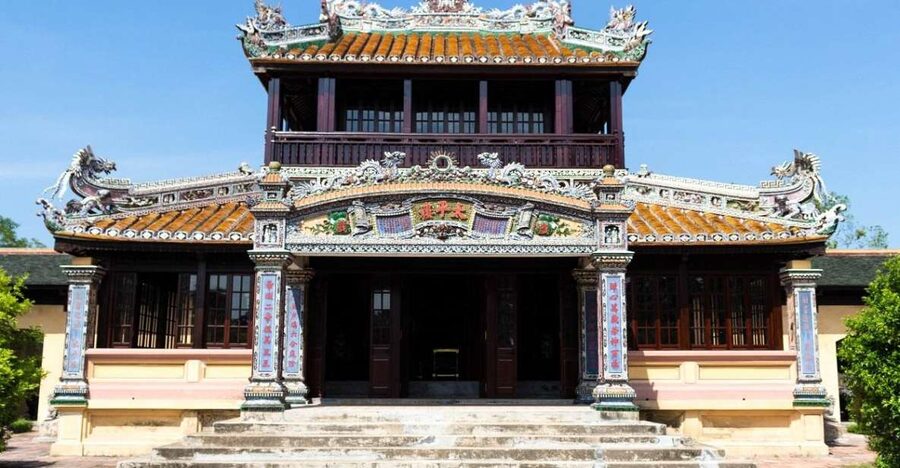
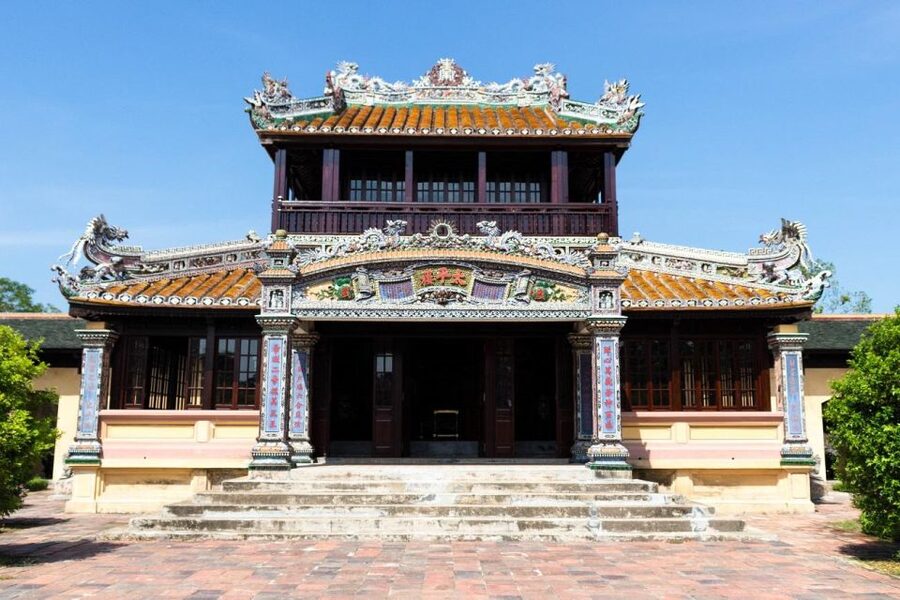
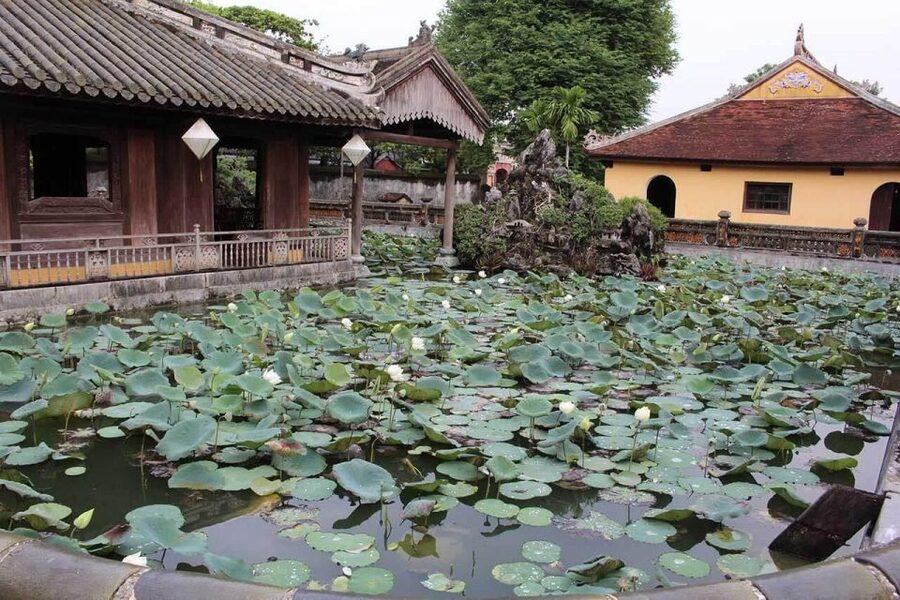
The route may include Kien Trung Palace, Thai Binh Pavilion, Thieu Phuong Garden, and Duyet Thi Duong Royal Theater. Each stop usually lasts between 10 and 15 minutes. Some are primarily photo stops, while others give your guide a chance to explain royal leisure, gardens, theater, and private court life.
The two-hour Imperial City portion gives you time to look around without being rushed. Guides are often willing to let you pause for photographs or examine exhibits independently. That flexibility is useful because the site is large and the most rewarding details are not always the grandest buildings.
What the 2.5-hour walk feels like
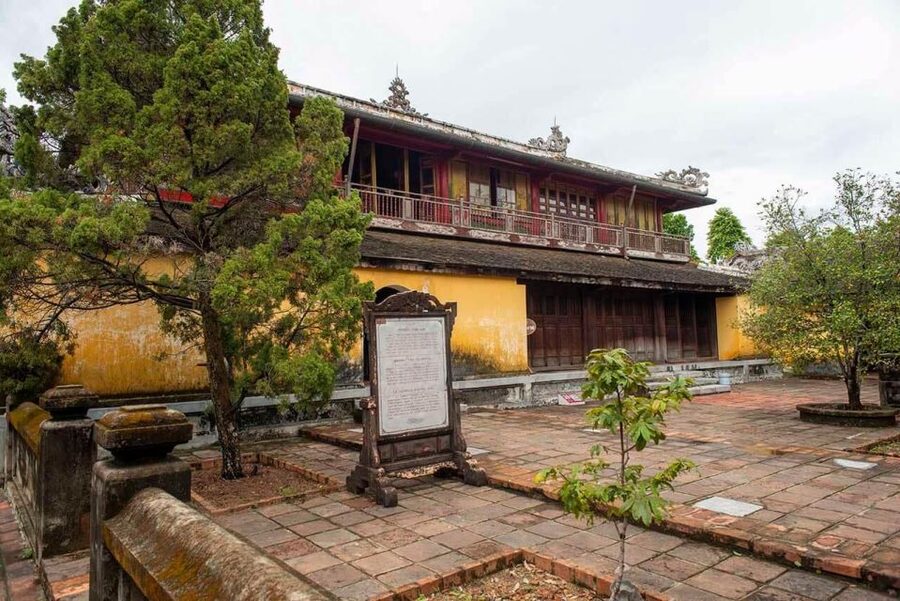
The walking route is best understood as a guided circuit, not a museum-style visit where you spend a long time inside one room. You move between gates, courtyards, temples, pavilions, gardens, and palace remains.
The overall distance is manageable for many people, but the experience is outdoors and weather matters. Guides have adjusted the pace during very hot days, used shaded areas for explanations, and allowed cooling breaks. The tour has also continued in rain, so bring protection rather than assuming Hue will be dry.
I would choose an early start if that option is available. A May morning visit at 8:30 was described as more comfortable before the sun became too strong. Comfortable walking shoes, water, sun protection, and a rain layer are sensible additions.
The small-group format is another advantage. Some bookings end up as private walks, especially when demand is light. That can give you more time for questions and let the guide adapt the explanation to your interests.
Building your own private-car day
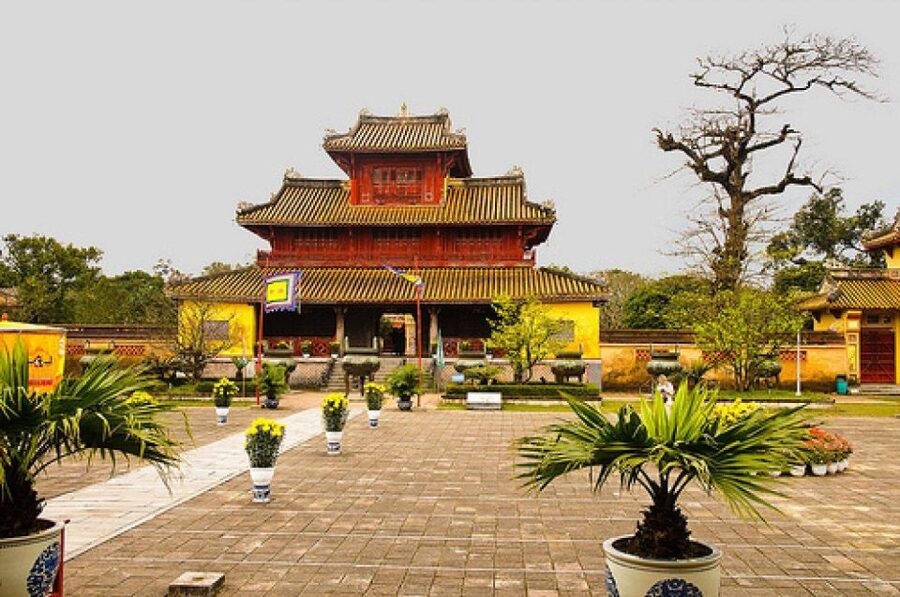
The private-car option is a different product from the walking tour. An English-speaking driver picks you up from a city-center hotel or Hue Railway Station, then takes you to the places you select.
The driver is there for communication and transport, not as a professional licensed guide. That distinction is important. If you want detailed explanations inside the Imperial City, choose the walking tour with a local guide or arrange a separate guide.
The available stops include:
- Imperial City
- Thien Mu Pagoda
- Minh Mang Tomb
- Tu Duc Tomb
- Khai Dinh Tomb
- Thuy Tien Abandoned Water Park
You can build a short outing around the Imperial City and Thien Mu Pagoda, or use the car for a longer day that includes royal tombs. The duration ranges from 150 minutes to eight hours, so check the exact option before paying.
The three tombs offer different settings and royal personalities. Minh Mang, Tu Duc, and Khai Dinh are not interchangeable stops, and seeing all three makes for a long day. The private car gives you control over the route, but you should confirm how much time is allocated at each place and which admission fees apply.
Thuy Tien Abandoned Water Park is the most unusual choice. It is not part of the traditional royal story, so it may suit you if you want a contrasting photo stop rather than another temple or tomb.
Pickup and drop-off are included for private-car trips at city-center hotels in Hue or Hoi An, Hue Railway Station, and Phu Bai Airport in Hue. Locations outside the stated areas may cost extra, so confirm your address before departure. The listed drop-off areas also include Hue, Hoi An, and Da Nang.
Admission costs and the real value of $12
The advertised starting price of $12 per person looks excellent, and it is good value for a guided walk or basic private transport. But the ticket cost is separate.
Admission to the Imperial City is listed as 200,000 Vietnamese dong per adult. Combo tickets are available at 420,000 dong for the Imperial City plus two tombs, or 530,000 dong for the Imperial City plus three tombs. Combo tickets are valid for two days, which can be useful if you are staying in Hue and want to split the sightseeing.
Food and drinks are also separate. You can buy them during the day, but do not treat the low tour price as the full cost of the outing.
For the walking option, the $12 is mainly paying for local interpretation and a planned route through a large historic site. I consider that a strong deal if you care about context. For the private car, the value depends on how many people share the vehicle and how many stops you choose. A group can make the transport cost reasonable, while a solo visitor may prefer the walking option for the citadel itself.
Who should choose each version
Choose the walking tour if:
- You want the Nguyen dynasty explained in clear English.
- You are visiting the Imperial City for the first time.
- You enjoy asking questions about symbols, architecture, and court life.
- You prefer a small group or the chance of a private guide.
- You want a focused visit lasting about 2.5 hours.
Choose the private car if:
- You want to connect the Imperial City with pagodas or royal tombs.
- You are staying outside central Hue and need transport.
- You want to set your own route and pace.
- You are comfortable sightseeing without a professional guide.
- You have up to eight hours for a broader day trip.
Families can do well with the walking option because the guides use stories and symbols rather than only dates. People who have already walked through the citadel alone may also find the guided visit worthwhile. The buildings do not change, but the way you understand them does.
Should you book this Hue tour?
I would book the walking option if the Imperial City is your main reason for visiting Hue. The price is low, the route covers the major royal sights, and the strongest part of the experience is the guide’s ability to explain how the court worked.
Misa, Nhi, Ha, Duy, Nhien, Linh, and other named guides have shown the qualities you want here: clear English, warmth, patience, humor, and a willingness to slow down for questions or photographs. That matters more than a long list of stops.
Choose the private car when you want a flexible sightseeing day rather than a history lesson. Just remember that the driver is not a professional guide and that entrance fees are extra.
The best booking decision is to match the format to your aim. For royal history and the Forbidden Purple City, take the guided walk. For tombs, Thien Mu Pagoda, airport transfers, or a custom route, take the car.
FAQ
Where does the walking tour meet?
You meet your guide at the four bronze cannons near Ngan Gate, or Cua Ngan, at the Citadel. The guide holds an A4 sheet with your name. Five cannons are on the opposite side, so check that you are at the correct group of four.
How long is the guided walking tour?
The walking option takes about 2.5 hours. The wider activity offers durations from 150 minutes to eight hours, depending on the option you select.
Is the Imperial City entrance ticket included?
No. Admission is listed separately at 200,000 Vietnamese dong per adult. Combo tickets are also available for the Imperial City with two or three tombs.
Does the private-car option include a tour guide?
No. The private-car option includes an English-speaking driver for communication and transport. A professional tour guide is included only with the walking-tour option.
Is hotel pickup available?
Pickup and drop-off are included for private-car trips from city-center hotels in Hue or Hoi An, Hue Railway Station, and Phu Bai Airport in Hue. An extra charge may apply for locations away from the city center, so confirm your address before departure.
Can I cancel or pay later?
You can cancel up to 24 hours before the activity for a full refund. Reserve-now, pay-later booking is available, so you do not need to pay at the time of reservation.
Just added around the world
- Secrets of Buda Castle: Self-Guided Puzzle Adventure in Budapest★ 5.0 · 8 reviews
- Budapest Hike to Visegrád Castle w or wo Sauna/Danube beach★ 5.0 · 11 reviews
- Castle District tour with Matthias Church Ticket & Cake & Coffee★ 5.0 · 31 reviews
- Buda Castle’s Secrets with a Historian★ 5.0 · 108 reviews
- Buda Castle Tour: History and Architecture★ 5.0 · 33 reviews
- Buda Castle Quarter Walking Tour★ 5.0 · 16 reviews
- Buda Castle Walking Tour with Matthias church entry, Cake&Coffee★ 4.5 · 21 reviews
- BloodThirsty Hungary – Castle District★ 5.0 · 80 reviews
Fortress & Citadel Tours, compared.

Full Day Taj Mahal, Agra Fort & Baby Taj Tour from Delhi by Car
Read our review →
Fort Sumter Admission and Self-Guided Tour with Roundtrip Ferry
Read our review →
Carcassonne: Castle and Ramparts Entry Ticket
Read our review →
Charleston: Fort Sumter Entry Ticket with Roundtrip Ferry
Read our review →
Same Day Taj Mahal, Fort & Baby Taj Tour from Delhi by Car
Read our review →
From Delhi: Taj Mahal and Agra Fort Private Sunrise Tour
Read our review →
Sunrise Taj Mahal, Agra Fort & Baby Taj Tour from Delhi by Car
Read our review →
Salzburg: Hohensalzburg Fortress Admission Ticket
Read our review →Browse the lists this tour appears in